


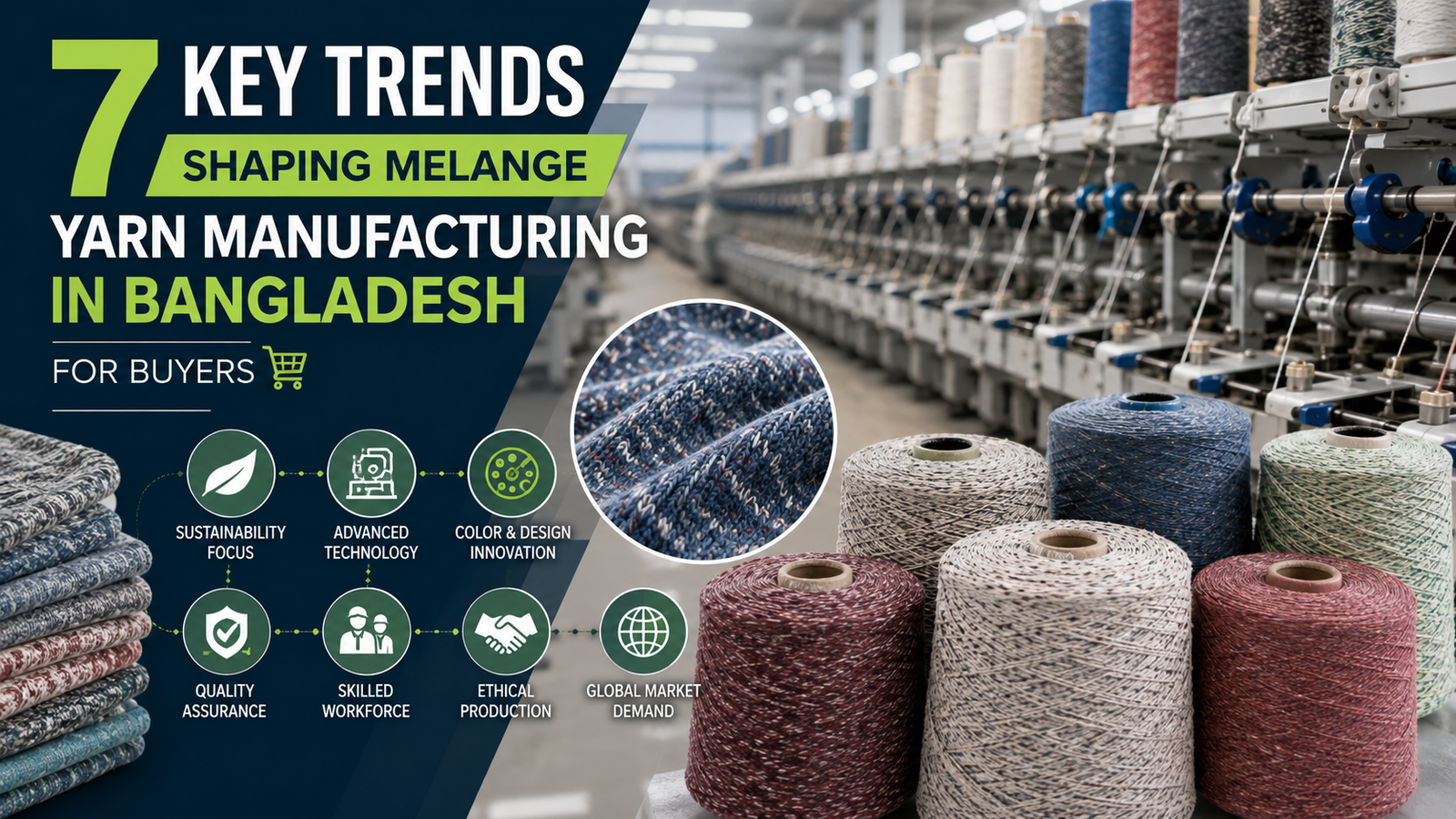
Sourcing managers comparing melange yarn suppliers in Bangladesh face a market that looks the same on paper but performs very differently in practice. Mill tiers vary widely in terms of certification, energy reliability, and exposure to the India-Bangladesh trade disruptions that disrupted import volumes through 2025. This guide breaks down the 7 trends that should shape a sourcing decision in 2026, plus a comparison table of what to ask before signing with a mill.
TL;DR
- Bangladesh is the world’s second-largest RMG exporter, recording USD 38.48 billion in export earnings in 2024 (Invest Bangladesh, 2025) – and melange yarn sits at the centre of its knitwear growth.
- Sustainable melange production – BCI-certified, GOTS-organic, and recycled-fibre blends – is now a non-negotiable for European and US buyers with ESG mandates.
- Bangladesh has more LEED-certified factories than any other country, with over 230 units (Invest Bangladesh, 2025), giving melange manufacturers a built-in compliance story.
- India currently accounts for the bulk of melange yarn imports, but trade route disruptions in 2025 are prompting Bangladeshi mills to expand domestic spinning capacity.
- Buyers sourcing melange yarn from Bangladesh in 2026 should audit for traceability tech, energy source, and fibre certification – not price alone.
What Is Melange Yarn and Why Does It Matter for Bangladesh Sourcing
Melange yarn is a blended or pre-dyed fibre yarn that produces a heathered, multi-tonal appearance in finished fabric – the signature look in casualwear, athleisure, and knitwear. It is spun from a mix of dyed and undyed fibres before spinning, rather than piece-dyed. This process uses significantly less water and fewer chemicals than conventional dyeing.
For buyers, melange yarn matters in Bangladesh above all for one reason: the country’s knitwear sector is its largest export earner. Knitwear contributed USD 20.52 billion to export earnings in 2024, outpacing woven garments at USD 17.95 billion (Invest Bangladesh, 2025). Most of that knitwear is made from cotton and cotton-blend melange yarn. Sourcing decisions at the yarn level directly impact lead time, compliance, and finished product cost.
How to Use This Guide
This article covers 7 trends that directly affect how buyers and sourcing managers should evaluate melange yarn suppliers and spinning mills in Bangladesh in 2026. Each section explains what is changing, why it matters to your supply chain, and what to look for when qualifying a supplier.
Trend 1: Domestic Melange Spinning Capacity Is Expanding to Reduce Import Dependency
Bangladesh produces roughly 1.7 million metric tons of yarn annually and is forecast to reach 1.8 million MT in the 2025-26 marketing year, comprising 1.3 million MT of cotton yarn and 500,000 MT of mixed yarn – up 5.8 percent from the prior year (USDA GAIN, 2025).
Despite this, Bangladesh still imports heavily. In 2024, yarn imports hit USD 1.85 billion, a 31.1 percent increase from USD 1.41 billion in 2023 (USDA GAIN, 2025). India supplies the majority of that volume, including most specialty melange and slub yarn.
That dependency is now a liability. Monthly yarn export volumes from India to Bangladesh dropped from around 100 million kilograms to approximately 90 million kilograms after India restricted Bangladeshi imports to two sea ports, following Bangladesh’s own land-port restrictions on Indian yarn (Apparel Resources, 2025).
Some mills are already ahead of this shift. Enayetpur Spinning Mills Ltd, a Karotoa Green facility in Narayanganj, runs 57,000 spindles producing roughly 870,000 kg of export-quality melange yarn annually, including BCI melange, organic melange, and slub yarn – the kind of dedicated melange capacity buyers should look for when qualifying a domestic alternative to imported yarn.
What to look for: Mills that have invested in ring-spinning upgrades for melange production and carry at least 30 days of raw fibre inventory. Ask directly about their India-sourced input ratio and what their contingency plan is if that corridor tightens further.
Trend 2: ESG-Compliant Melange Yarn Is Now a Buyer Prerequisite, Not a Premium Option
Buyers across Europe and the US are tightening compliance expectations on supply chains, and Bangladeshi RMG factories – already leaders in LEED-certified production – are aligning with suppliers who can meet similar environmental standards upstream (Apparel Resources, 2025).
For melange yarn specifically, this plays out in three ways:
- Fibre certification: BCI cotton, GOTS organic, and GRS recycled are now required as standard by major European retailers. Indian exporters supplying mélange and slub yarns dyed with less water and fewer chemicals are gaining an advantage over competitors as buyers are driven by ESG metrics (Apparel Resources, 2025). Bangladeshi mills need to match this.
- Chemical compliance: Melange yarn’s pre-dyeing process is less water-intensive than piece-dyeing, but chemical use must still meet ZDHC (Zero Discharge of Hazardous Chemicals) standards. ZDHC conformance is now referenced in audits run by Sedex, WRAP, and Amfori BSCI.
- Traceability documentation: Tools like TextileGenesis, TrusTrace, and Sourcery are becoming industry standards for certified supply chains (Fibre2Fashion, 2025). A supplier unable to provide digital batch verification is a sourcing risk for brands shipping to regulated EU markets.
Mills holding GOTS, BCI, OCS, and BSCI certifications together – rather than just one – gives buyers a single-supplier path to multiple compliance requirements. Enayetpur Spinning Mills Ltd is one example of a Bangladeshi facility that holds this combined certification alongside dedicated organic and BCI-melange production lines.
What to look for: Confirm GOTS, GRS, or OEKO-TEX certification at the spinning level – not just at the garment factory. Request a Higg Facility Environmental Module (FEM) score if available.
Trend 3: Recycled-Fibre Melange Is Growing as a Category
Recycled melange – yarn spun from pre-consumer cotton waste or recycled polyester blended with virgin cotton – is moving from niche to mainstream. Recycled yarn prices in Bangladesh reached USD 3.35/kg in March 2025, reflecting rising demand from the RMG sector (Accio, 2025).
The circular economy argument is direct for melange: the pre-spinning blend process is already compatible with recycled fibre inputs without the visual inconsistency that affects solid-dyed yarns. Recycled content does not compromise the heathered appearance – it often enhances it.
In Fakir Eco Knitwears’ LEED Gold-certified factory in Narayanganj, AI-driven cutters allow workers to recycle 95% of fabric scraps into new yarns (MIT Technology Review, 2025). This kind of closed-loop production at the garment level is creating upstream demand for GRS-certified recycled melange yarn from spinning mills.
What to look for: Ask for the GRS (Global Recycled Standard) transaction certificate for recycled-content melange. Check whether the supplier has a documented chain of custody for the waste fibre input.
Trend 4: Bangladesh’s Green Factory Infrastructure Gives Melange Manufacturers a Compliance Advantage
Bangladesh has the highest number of green garment factories globally, with over 230 LEED-certified units, including 92 platinum and 124 gold (Invest Bangladesh, 2025). This is not just a garment-level story – it creates bottom-up pressure on yarn suppliers to match the environmental standards that the factories they supply already hold.
Spinning mills that have adopted renewable energy have a concrete cost and compliance advantage. Energy costs are a material risk: domestic gas output in Bangladesh slipped to roughly 2,200 mmcfd in 2025 against industrial demand of over 2,800 mmcfd, forcing mills to burn diesel at costs 30-40% above piped gas (Mordor Intelligence, 2026). Mills with solar installations or gas-grid priority access have lower operating risk and more stable pricing.
What to look for: Ask the mill for its energy mix – percentage from grid, captive gas, solar, and diesel. A high diesel dependency is a price stability red flag, particularly for forward contracts.
Trend 5: Synthetic-Blend Melange Is Gaining Share in the Product Mix
Synthetic fibres led Bangladesh’s textile manufacturing market with a 36.99% share in 2025, and polyester yarn is projected to grow at a 6.85% CAGR through to 2031 (Mordor Intelligence, 2026).
This matters for melange buyers because the category is no longer predominantly cotton. Cotton-polyester blended melange (typically 60/40 or 50/50) is growing in activewear and functional casualwear. These blends offer better stretch recovery and moisture management at a lower cost than 100% cotton melange. Blended yarn prices for 60/40 cotton-polyester increased in late 2024 (Accio, 2025), reflecting genuine demand rather than a price spike.
Buyers sourcing melange for athleisure or performance categories should specifically ask spinning mills about their blended melange counts – particularly 20s, 24s, and 30s ring-spun blends – and whether they carry OEKO-TEX 100 certification for the synthetic component.
What to look for: Confirm the polyester source (virgin vs. recycled), and whether the GRS applies to the polyester content in the blend. This affects your scope 3 reporting.
Trend 6: Digital Traceability Is Becoming a Contractual Requirement from Major Brands
ESG reporting has become central to maintaining market access, meeting buyer expectations, and sustaining global credibility for Bangladesh’s RMG supply chain (Texspace Today, 2026). That pressure now flows upstream to yarn suppliers.
Brands like M&S and Tommy Hilfiger already require traceable, certified inputs at the yarn level. Manan Textech Global has begun supplying niche biodegradable yarns to these buyers, who specifically request sustainable, verifiable supply chains rather than simply certified fabric (Apparel Resources, 2025).
For melange yarn in Bangladesh, traceability means the ability to document: fibre origin and certification, spinning batch records, dye lot chemical compliance, and transport chain. Mills operating on paper-based systems cannot meet this requirement for forward-facing buyers in 2026 and beyond.
What to look for: Ask whether the mill uses any digital traceability platform. Even a basic ERP system with exportable batch records is a starting baseline. Blockchain-backed systems (referenced by brands auditing to EU Supply Chain Due Diligence standards) are the direction of travel.
Trend 7: Price Competitiveness Is Real but Not Uniform Across Mill Tiers
Bangladesh is cost-competitive in yarn, but the gap between tier-1 and tier-3 mills is wide. Indian yarn delivered to Chattogram port is priced at approximately USD 2.19/kg, below locally produced Chittagong yarn at USD 2.45/kg even after government incentives (Apparel Resources, 2025).
This means Bangladeshi domestic melange spinning still carries a cost premium over imported Indian yarn. However, that premium is justified in three specific cases: when lead time is the priority, when the buyer requires a Bangladesh-origin yarn certificate for rules-of-origin compliance, or when the vertically integrated mill can offer traceability that import-sourced yarn cannot.
Bangladesh is currently using only roughly half of its total raw cotton processing capacity of 15 million bales annually (Mordor Intelligence, 2026), which means there is headroom for mills to scale melange production without major capital constraints – if buyers commit to volume.
What to look for: Request ex-mill pricing for your target counts (typically 20s-40s for melange knitwear) and compare against the landed cost of Indian-origin alternatives. Factor in lead time, payment terms, and the cost of compliance documentation when calculating the total cost of ownership.
Supplier Comparison: What to Ask Melange Yarn Mills in Bangladesh
| Evaluation Criterion | What to Ask | Why It Matters |
| Fibre certification | GOTS / BCI / GRS certificate number and validity | Required for EU and US retailer compliance |
| Energy source | % from solar, grid, diesel, captive gas | Affects price stability and Scope 2 reporting |
| Traceability platform | ERP system, TextileGenesis, or equivalent | Needed for digital audit trails |
| Yarn counts available | Ne 20s, 24s, 30s, 40s melange | Confirms fit for knitwear applications |
| Recycled content option | GRS transaction certificate available? | Required for recycled-melange product lines |
| Indian yarn input ratio | % of raw fibre sourced from India | Supply chain disruption risk indicator |
| LEED or OEKO-TEX status | Factory certification documentation | Baseline buyer compliance requirement |
Frequently Asked Questions About Melange Yarn Manufacturing in Bangladesh
What is melange yarn, and how is it different from regular dyed yarn?
Melange yarn is made by blending dyed and undyed fibres before spinning, creating a heathered appearance in the finished fabric. Regular yarn is typically dyed after spinning or after fabric construction (piece dyeing). Melange production uses less water and fewer chemicals than piece dyeing, making it a lower-impact option for buyers with sustainability requirements.
Is Bangladesh a reliable source for melange yarn in 2026?
Yes, with caveats. Bangladesh has significant spinning capacity and a cost-competitive labour base. The main risks are energy supply gaps (gas shortages forcing diesel use), import dependency on Indian raw cotton and specialty yarn, and variable compliance levels across mill tiers. Tier-1 mills attached to LEED-certified garment factories are the most reliable option.
What certifications should I require from a melange yarn supplier in Bangladesh?
At minimum, request OEKO-TEX Standard 100 for chemical safety, GOTS or BCI certification if you need organic or sustainable cotton claims, and GRS if your spec calls for recycled-fibre content. For brands reporting under EU CSRD or US Uyghur Forced Labour Prevention Act requirements, ask for a full chain-of-custody document from fibre origin to spinning. For reference, mills like Enayetpur Spinning Mills Ltd in Narayanganj carry GOTS, BCI, OCS, and BSCI certifications concurrently, which is a useful benchmark when evaluating other suppliers.
How does the disruption to the India-Bangladesh yarn trade affect melange sourcing?
India supplies the majority of Bangladesh’s yarn imports, including specialty melange and slub yarn. Since 2025, land-route restrictions between the two countries have reduced import volumes and added logistics costs. Buyers should ask mills about their current India-sourced input ratio and confirm they have alternative sourcing plans or adequate safety stock.
What counts of melange yarn are most commonly produced in Bangladesh?
The most common ring-spun melange counts for knitwear applications are Ne 20s, 24s, 30s, and 40s in 100% cotton and 60/40 cotton-polyester blends. Open-end melange in coarser counts (Ne 6s-16s) is also produced for fleece and sweatshirt applications. Confirm the availability of counts and minimum order quantities before committing to a supplier.
What is the price range for melange yarn from Bangladesh in 2026?
Domestic Bangladesh melange yarn is priced at approximately USD 2.45/kg for standard counts, compared to roughly USD 2.19/kg for Indian-origin yarn landed at Chattogram. GOTS-certified or recycled-blend melange commands a 15-30% premium over conventional equivalents. Factor in lead time, compliance documentation, and payment terms before comparing on price alone.
Key Takeaways for Buyers and Sourcing Managers
- Bangladeshi melange yarn manufacturing is expanding, but domestic capacity still falls short of total demand – import dependency on India remains a live supply chain risk.
- ESG compliance at the yarn level is now a prerequisite, not a premium: request fibre certification, ZDHC chemical compliance, and digital traceability documentation.
- The most competitive suppliers in 2026 are vertically integrated mills attached to LEED-certified facilities, with renewable energy sources and documented batch traceability.
- Price comparison with Indian-origin yarn should account for total sourcing cost – including compliance documentation, lead time, and rules-of-origin requirements – not ex-mill price alone.