


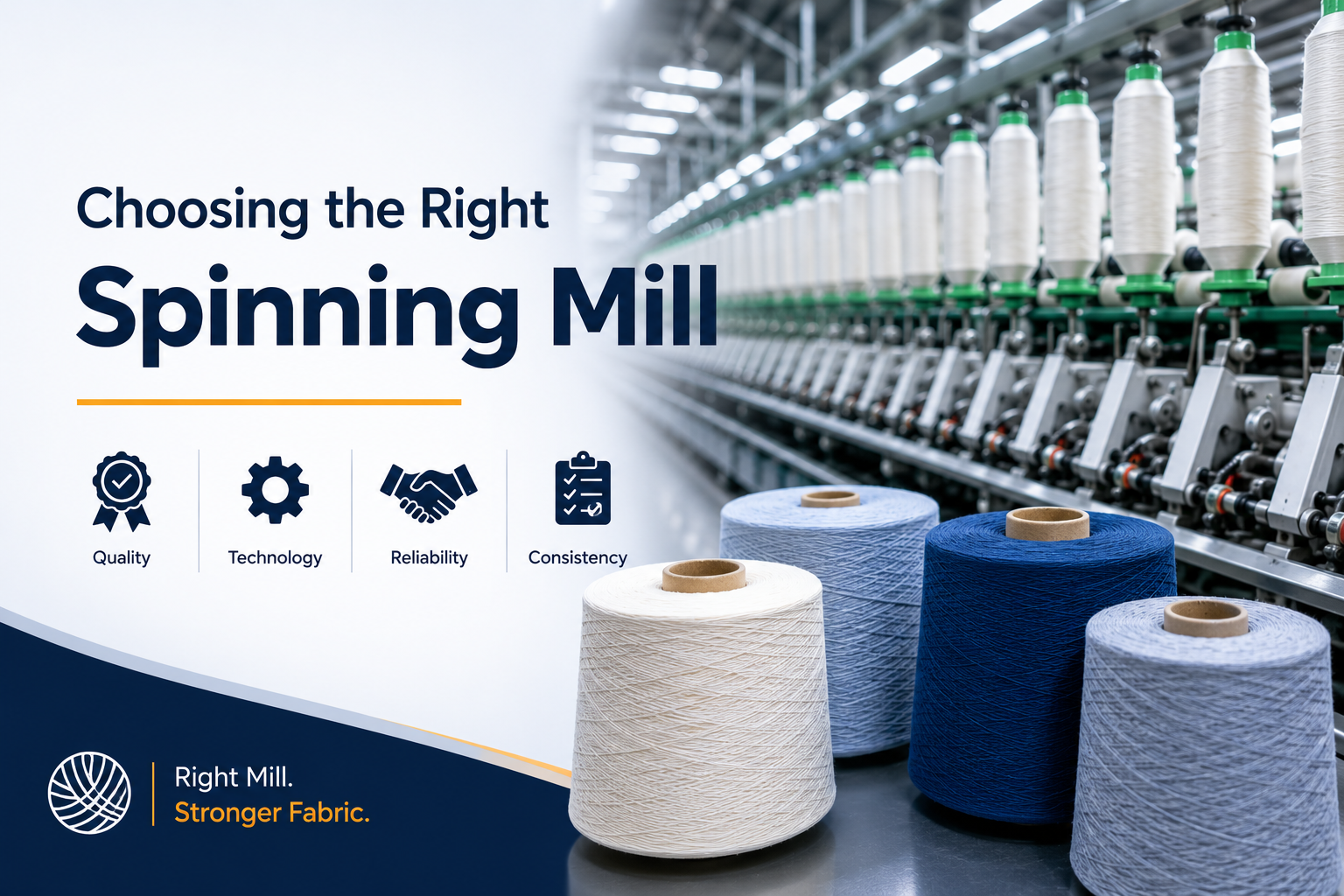
A spinning mill converts raw fiber, usually cotton, polyester, or blends, into yarn that knitting and weaving factories turn into fabric. The strength, evenness, and consistency of that yarn carry through to every stage that follows, from knitting efficiency to dye uptake.
Buyers who compare suppliers solely on price per kilogram often miss the bigger cost driver: yarn that breaks during production, dyes unevenly, or produces fabric defects, which cost far more than the savings on the invoice. Choosing a spinning mill is a sourcing decision that affects production efficiency, not just a line item on the purchase order.
TL;DR
- Yarn quality sets the ceiling for fabric quality. Problems in spinning show up later as breakage, uneven dyeing, and rejected fabric lots.
- The cheapest yarn per kilogram is rarely the cheapest overall once downtime, waste, and returns are factored in.
- Define fiber type, yarn type, count, and end use before requesting a quotation – a supplier can only recommend the right product if they know how the yarn will be used.
- Ask for recent lab reports covering count variation, tensile strength, evenness, and imperfection index instead of relying on marketing claims.
- Bangladesh has grown into a major yarn sourcing hub, but quality still varies mill to mill, so each supplier needs individual evaluation.
How Poor Yarn Quality Increases Your Total Production Cost
Yarn problems rarely stay contained to the spinning stage. They surface later, often after fabric has already been knitted or dyed, when the fix is far more expensive.
Common downstream effects of poor yarn quality include:
- Yarn breakage forces operators to stop machines and repair broken ends, which cuts knitting or weaving efficiency even when each stoppage is brief.
- Shade variation after dyeing often stems from inconsistent yarn count or unevenness that wasn’t visible during knitting.
- Barre marks and streaks in finished fabric frequently result in costly rejection or reprocessing.
- Higher waste and more rejected lots add labor and material costs that doesn’t show up in the original yarn price.
A knitting factory running thousands of kilograms of jersey fabric a day feels this most directly: repeated yarn breaks add up to significant lost machine time, even at a few minutes per stoppage. Reliable mills reduce these risks by holding yarn count, strength, evenness, and cleanliness within tight, consistent limits.
What to Define Before You Contact a Spinning Mill
A supplier can only quote accurately and recommend the right yarn when they know exactly how it will be used. Missing specifications is one of the most common reasons buyers receive yarn that doesn’t fit their production line. Prepare the following before you request a quotation.
Fiber Type
Fiber choice affects softness, durability, moisture management, dyeability, shrinkage, and cost. Common options include:
- Cotton (conventional, organic, or recycled) is chosen for comfort and breathability in apparel.
- Polyester (virgin or recycled) offers strength, dimensional stability, and lower cost.
- Cotton-polyester blends balance comfort with durability and easier care.
- Viscose drapes well and takes dye easily, making it common in fluid, lightweight fabrics.
- Modal, bamboo, and lyocell are common in premium apparel for their softness and moisture handling.
Select fiber based on end use and customer expectations, not price alone.
Yarn Type
Spinning mills produce several yarn types, each suited to different fabric outcomes.
| Yarn Type | Known For | Typical Use |
| Ring-spun | Strength, soft hand feel | Premium knitwear |
| Compact | Low hairiness, high strength | Fine fabrics |
| Open-end (OE) | Lower cost, less critical appearance | Basic fabrics, denim |
| Combed | Removes short fibers, smoother yarn | Higher-end apparel |
| Slub | Textured, irregular thickness | Fashion fabrics |
| Melange | Blended color fibers | Heather knitwear |
| Core-spun | Elastic core wrapped in fiber | Stretch fabrics, denim |
| Siro | Two-strand twist without plying | Fine, low-hairiness fabrics |
| Multi-fold | Two or more yarns twisted together | Sewing thread, heavier fabrics |
Melange and other specialty yarns require precise fiber blending before spinning. Uneven blending results in visible shade variation in the finished fabric, so buyers sourcing heather knitwear should closely review a mill’s blending process. Melange sourcing in Bangladesh has its own certification and pricing quirks that are worth understanding before you commit to a supplier.
Yarn Count
Yarn count sets the fineness or thickness of the yarn, which directly affects fabric weight and appearance. Lower counts (e.g., Ne 20-24) produce thicker, stronger yarns for heavier fabrics. Higher counts (Ne 40-60) produce finer yarn for lightweight garments.
Always specify both the target count and your acceptable tolerance range when you need strict consistency across production lots.
End Use
The same yarn count can require different properties depending on how it’s used. Knitting yarn generally needs high flexibility and low imperfections. Weaving yarn needs greater tensile strength to handle the loom tension. Towel yarn prioritizes absorbency, while denim yarn requires entirely different strength and twist characteristics.
Never assume a supplier already knows your end use. State it explicitly in every inquiry.
Why Raw Material Quality Determines Yarn Quality
Even advanced spinning machinery can’t consistently produce premium yarn from poor fiber. Experienced buyers spend as much time evaluating raw materials as they spend evaluating the spinning process itself.
Cotton Origin
Cotton origin affects staple length, strength, micronaire, color, and cleanliness. Many mills source from multiple countries, including the United States, Brazil, Australia, India, and West Africa, and blend origins to maintain stable yarn performance through seasonal changes. Ask a supplier how they manage origin changes and whether blending is part of their process.
Fiber Length
Longer fibers generally produce higher yarn strength, better spinning performance, lower hairiness, and fewer breaks. Short fibers increase imperfections and reduce production efficiency. Buyers rarely specify exact staple length, but understanding a mill’s typical fiber quality gives a useful signal for expected yarn performance.
Micronaire
Micronaire measures fiber fineness and maturity. Fiber with an extremely low or high micronaire value creates spinning difficulties and inconsistent dyeing. Mills that monitor micronaire carefully during raw material selection tend to produce more consistent yarn.
Contamination Control
Foreign fibers, including plastic fragments, polypropylene, leaf particles, and seed coat fragments, are a leading cause of fabric defects, especially visible in light-colored fabric after dyeing. Ask suppliers what automated systems they use to detect and remove contamination during blowroom processing.
What Machinery and Automation Tell You About a Mill
Modern machinery improves precision and reduces waste, but equipment alone doesn’t guarantee quality. Maintenance discipline and skilled technicians matter just as much.
Established equipment brands used across the industry include Rieter, Trützschler, Lakshmi Machine Works, Murata, Savio, Schlafhorst, and Toyota Textile Machinery. Production lines built around this equipment typically include automated bale opening, precision carding, high-speed drawing frames, and electronic yarn clearers that monitor quality continuously.
Automation helps reduce thick and thin places, hairiness, neps, end breakage, and count variation. Real-time monitoring lets a mill catch quality deviations before they become large-scale problems.
Don’t assume newer machinery automatically means better yarn. A well-maintained line run by experienced technicians often outperforms a newer factory with weak maintenance practices. When evaluating a mill, ask how often equipment is calibrated and upgraded, not just what brand it runs.
How to Evaluate a Mill’s Quality Control System
Machinery is only as effective as the quality system behind it. Mills that check quality only at the end of the line discover problems too late, after waste has already piled up.
Raw Material Inspection
Before fiber enters production, a reputable mill checks incoming shipments for staple length, fiber strength, micronaire, moisture content, trash percentage, color grade, and contamination level. This step keeps yarn quality consistent even as raw material availability shifts seasonally.
In-Process Quality Control
Leading mills monitor quality at every stage rather than waiting for the finished yarn. Typical checks cover silver weight consistency, roving quality, drafting performance, twist level, count, end-break frequency, and winding efficiency. Continuous monitoring catches abnormalities early and reduces waste between lots.
Laboratory Testing
Always ask what lab tests a mill runs before shipment. Common tests include count verification, count variation, tensile strength, elongation, evenness (U%), imperfection index (IPI), hairiness, and moisture regain. Request recent lab reports for the specific count you plan to buy rather than relying on marketing claims. Objective test data is the clearest way to compare suppliers on measurable performance.
Production Capacity and Delivery Reliability
Technical skill is only half the evaluation. A mill also needs enough capacity and operational stability to support your order volume long-term.
Before placing a large order, ask:
- What is your monthly spinning capacity, and which counts do you produce regularly?
- What is your average lead time, and how do you handle urgent orders?
- How many production shifts run each day, and what share of output goes to export?
- Is production vertically integrated, or do you rely on subcontractors?
- Do you offer safety stock programs for repeat customers?
Large theoretical capacity isn’t an advantage if delivery is inconsistent. Vertically integrated operations generally give buyers better visibility into quality and timing than mills that depend on subcontractors.
Certifications Worth Verifying
Certifications don’t guarantee excellent yarn on their own, but they show a mill has implemented structured management systems and passed an independent assessment. Depending on your market, check for:
- ISO 9001 for quality management systems.
- OEKO-TEX Standard 100 for product safety and restricted substances.
- Global Organic Textile Standard (GOTS) for organic textile production.
- Global Recycled Standard (GRS) for recycled fiber content.
Request current certificates and confirm they apply to the specific facility and products you plan to buy, not just the company name.
Sustainability Factors Worth Asking About
Brands and retailers increasingly expect transparency in how yarn is produced. When evaluating a mill’s sustainability practices, ask about energy-efficient machinery, water conservation, waste recycling systems, responsible fiber sourcing, and worker health and safety programs. Ask for specific examples and how those efforts are measured, rather than accepting broad claims at face value.
Comparing Total Cost, Not Just Yarn Price
Price per kilogram is usually the first number buyers compare, but it shouldn’t be the only one. Lower-priced yarn can become more expensive overall if it causes higher downtime, more waste, additional inspections, higher rejection rates, or delayed shipments.
A yarn priced slightly higher may cause fewer machine stoppages and less waste across a large production run, which can outweigh the initial price difference. Evaluate suppliers on total cost of ownership, not just the invoice price.
Questions to Ask Before Selecting a Spinning Mill
Prepare a structured checklist before making a final decision:
- Which fiber origins do you currently use, and how do you manage changes between them?
- Can you provide recent laboratory test reports for the count I need?
- What quality inspections happen during production, not just at the end?
- How do you handle customer complaints and quality claims?
- What is your standard lead time, and can you run a trial order first?
- Which certifications does your facility currently hold?
- What is your monthly production capacity for my required count?
- Who will be my primary technical contact?
How clearly and specifically a supplier answers these questions often tells you as much as the answers themselves.
Red Flags to Watch For
Be cautious if a supplier cannot provide lab test reports, avoids technical questions, frequently changes quoted specifications, offers unusually low prices without explanation, or responds slowly during the quotation process. One warning sign alone doesn’t disqualify a supplier, but several together warrant investigation before placing a large order.
Why Bangladesh Has Become a Major Yarn Sourcing Hub
Bangladesh has built one of the world’s largest textile manufacturing bases over the past two decades, supported by a large garment export industry and continued investment in spinning, knitting, dyeing, and finishing capacity. Many Bangladeshi mills now run automated production lines and dedicated quality labs capable of supplying international apparel brands.
Capability still varies from one manufacturer to another, so it’s worth evaluating each mill individually rather than assuming a country-wide reputation applies evenly. Karotoa Green, which has been running spinning operations since 1987, is a reasonable example of the vertically integrated, certification-backed capacity buyers should look for. A handful of similarly capable mills are worth knowing by name, too, and we’ve profiled several of the top ones if you want to compare options directly.
Frequently Asked Questions About Choosing a Spinning Mill
What is the most important factor when choosing a spinning mill?
Consistency matters more than price alone. A mill that delivers stable count, strength, and evenness lot after lot reduces downtime and fabric rejects, which usually outweighs a lower per-kilogram price.
How do I know if a spinning mill’s yarn quality is reliable?
Request recent laboratory test reports for the specific yarn count you plan to buy, covering count variation, tensile strength, evenness, and imperfection index, rather than relying on the mill’s marketing claims.
What certifications should I check for a spinning mill?
Common ones include ISO 9001 for quality management, OEKO-TEX Standard 100 for product safety, and GOTS or GRS for organic or recycled material traceability.
How does yarn count affect fabric quality?
Lower counts produce thicker, stronger yarn suited to heavier fabrics. Higher counts produce finer yarn for lightweight garments. An incorrect count can lead to excess fabric weight or a poor appearance.
What are common red flags when evaluating a spinning mill?
Inability to provide lab reports, reluctance to answer technical questions, and unexplained ultra-low pricing are all signals worth investigating before placing a large order.
Should I choose a spinning mill based solely on price?
No. The cheapest yarn per kilogram can end up costing more overall through breakage, waste, rejected fabric, and delayed shipments. Compare total production cost, not just the invoice price.
Key Takeaways
- Define fiber, yarn type, count, and end use before requesting quotations.
- Raw material quality, including origin, fiber length, micronaire, and contamination control, sets the ceiling for yarn quality.
- Ask for recent lab test data rather than accepting marketing claims.
- Evaluate capacity, lead time, and communication alongside technical capability.
- Compare total production cost, not just price per kilogram.