


Ending the Confusion: Full Stack vs Backend vs Frontend
If you are hiring for a software role, planning a development project, or simply trying to understand the technology industry better, you have likely encountered three closely related but distinct terms: frontend development, backend development, and full stack development. While these terms get used interchangeably in casual conversation, they represent fundamentally different skill sets, responsibilities, and career paths. This guide provides a clear, practical breakdown of each role to help you make better hiring and project planning decisions.
What Is Frontend Development?
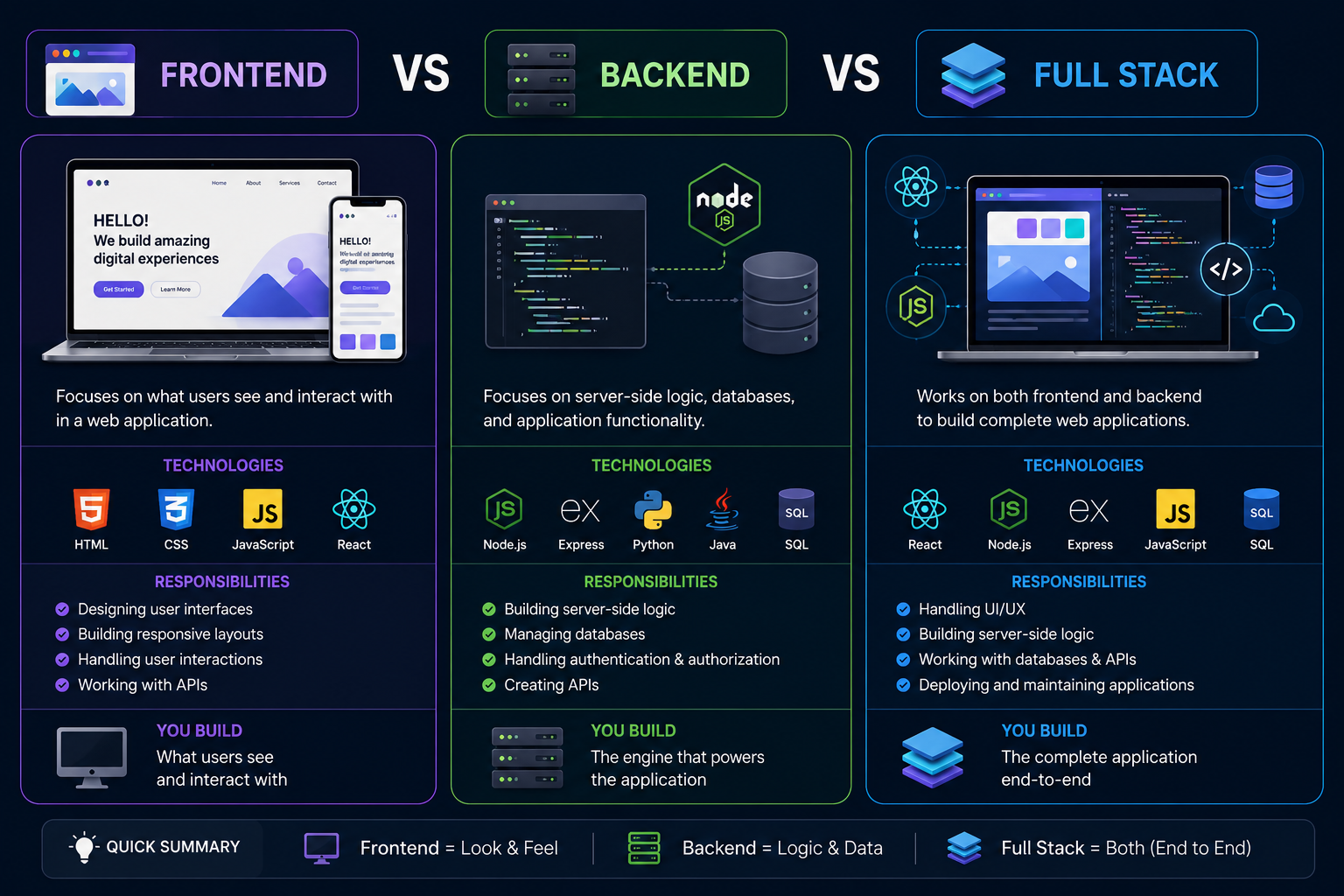
Frontend development focuses exclusively on the parts of an application that users directly see and interact with. This includes everything from layout and visual design implementation to interactive elements like buttons, forms, animations, and navigation menus. Frontend developers are responsible for translating design mockups into functional, responsive code that works correctly across different browsers, devices, and screen sizes.
Core frontend technologies include HTML for structure, CSS for styling, and JavaScript for interactivity, typically implemented through frameworks like React, Angular, or Vue.js. Frontend developers also need to understand web accessibility standards, performance optimization techniques, and increasingly, how to work with design systems and component libraries that ensure visual consistency across large applications.
Companies hire dedicated frontend developers when they need someone deeply specialized in creating polished, performant user interfaces, particularly for consumer-facing products where user experience directly impacts business metrics like conversion rates and customer retention.
What Is Backend Development?
Backend development encompasses everything happening behind the scenes that users never directly see but that powers the entire application. This includes server configuration, database design and management, application programming interfaces (APIs) that allow different software systems to communicate, business logic implementation, and security infrastructure.
Backend developers commonly work with languages like Python, Java, Node.js, Ruby, or PHP, alongside database technologies including PostgreSQL, MySQL, MongoDB, and Redis. They are responsible for ensuring applications can handle user load efficiently, that data is stored securely and accurately, and that the various services powering an application communicate reliably with one another.
Organizations typically hire dedicated backend developers when building applications with complex data processing requirements, high transaction volumes, or significant integration needs with third-party systems and services.
What Is Full Stack Development?
Full stack development combines both frontend and backend expertise within a single individual or team capability. Rather than specializing exclusively in user-facing interfaces or server-side architecture, full stack developers possess working knowledge across the entire technology stack, enabling them to build complete, functional applications independently.
This does not mean full stack developers are necessarily experts at the same depth level as dedicated specialists in either discipline. Rather, full stack development represents breadth of capability, allowing individuals or small teams to handle end-to-end project requirements without requiring separate specialists for every component.
Comparing the Three Approaches: Which Is Right for Your Project?
The decision between hiring specialized frontend and backend developers versus full stack generalists depends significantly on your specific project requirements and organizational structure.
Choose specialized roles when: Your project has significant complexity on either the frontend or backend side that genuinely requires deep specialization. Large enterprise applications with sophisticated user interfaces or complex distributed backend systems often benefit from dedicated specialists who can focus exclusively on optimizing their respective domains.
Choose full stack development when: You are building a startup MVP, working with limited budget or timeline constraints, or running a smaller engineering team where flexibility and reduced communication overhead provide more value than maximum specialization depth.
How Team Composition Affects Project Success
Many successful engineering organizations in the United States actually employ a hybrid approach, combining full stack generalists who can move fluidly between different parts of the application with specialized frontend or backend experts who dive deep into particularly complex or critical system components.
This hybrid model provides flexibility for handling diverse project demands while still maintaining deep expertise where it matters most. Smaller startups often begin with full stack generalists during early development phases, gradually adding specialized roles as the application grows in complexity and specific bottlenecks emerge that require deeper expertise.
Career Implications: Specializing vs Going Full Stack
For individuals navigating their software engineering career path, the choice between specializing in frontend, backend, or pursuing full stack capability carries significant implications. Specialists often command premium compensation for deep expertise in high-demand areas, particularly in backend architecture for high-scale systems or frontend performance optimization for consumer applications with massive user bases.
Full stack developers, meanwhile, benefit from greater career flexibility and resilience against market shifts that might reduce demand for any single specialization. They are also frequently better positioned for roles involving rapid prototyping, startup environments, or technical leadership positions that require understanding the complete system architecture.
Making the Right Hiring Decision
Ultimately, there is no universally correct answer between frontend, backend, and full stack development. The right choice depends entirely on your specific project requirements, team structure, budget constraints, and long-term technical strategy.
For businesses uncertain which approach best fits their needs, consulting with experienced engineering firms can provide valuable guidance based on similar past projects. Browse our directory of verified software development companies across the United States, spanning full stack generalists and specialized frontend and backend firms, to find the right technical partner for your specific project requirements.
Real-World Examples of Each Approach
Consider a large e-commerce platform processing millions of transactions daily. This type of application typically benefits from dedicated backend specialists who can optimize database query performance, implement robust caching strategies, and ensure transaction integrity at scale, working alongside dedicated frontend specialists focused on conversion-optimized checkout flows and product browsing experiences.
Conversely, consider an early-stage startup building its first customer-facing application with limited funding and an aggressive timeline. This scenario often favors full stack developers who can move quickly across the entire application without the coordination overhead required when specialized frontend and backend teams must constantly synchronize their work.
How Team Size Influences This Decision
Organization size and engineering team scale significantly influence the optimal balance between specialization and full stack capability. Small teams of five or fewer engineers typically benefit most from full stack generalists who provide maximum flexibility for handling whatever tasks emerge. As teams grow beyond fifteen or twenty engineers, increasing specialization usually becomes more efficient, allowing individuals to develop deeper expertise in their specific domain while reducing the cognitive load of constantly context-switching between frontend and backend concerns.