


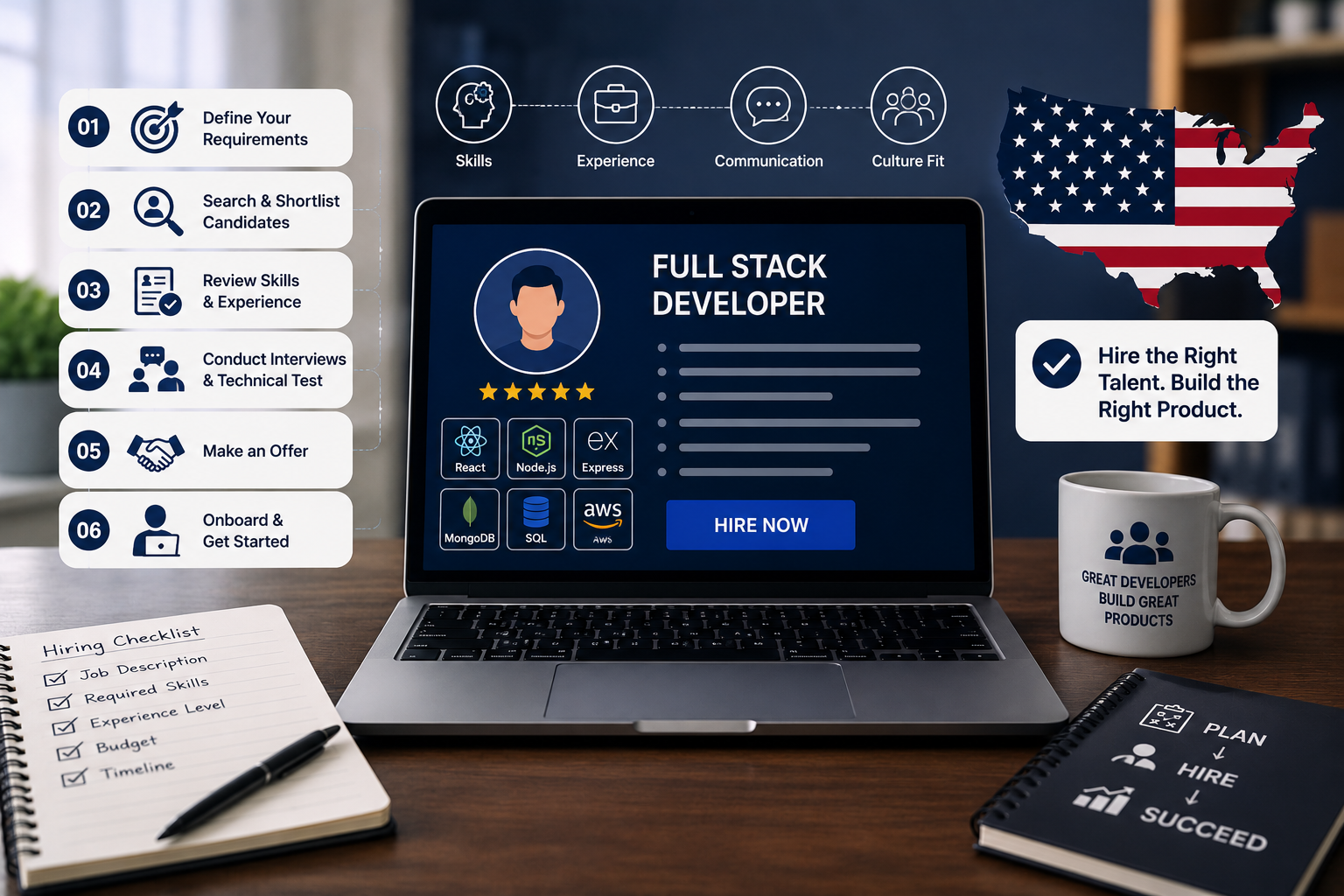
The Challenge of Hiring Full Stack Developers in Today’s Market
Hiring a qualified full stack developer in the United States has become one of the most challenging tasks facing technical hiring managers and business owners alike. With demand consistently outpacing supply, companies that approach hiring without a clear strategy often find themselves losing top candidates to competitors, paying inflated salaries for mediocre talent, or worse, making costly hiring mistakes that set projects back by months.
This step-by-step guide draws on proven hiring practices used by leading American engineering firms to help you navigate the full stack hiring process successfully, whether you are building an in-house team or evaluating an external development partner.
Step 1: Define Your Actual Technical Requirements
Before posting a single job listing or contacting a development agency, clearly define what your project actually requires. “Full stack developer” is a broad term, and the specific technologies, experience level, and domain expertise needed vary enormously between projects.
Ask yourself: Does this project require deep e-commerce experience, healthcare compliance knowledge, or fintech security expertise? Will the developer need to work with existing legacy systems, or are they building something entirely from scratch? Answering these questions upfront prevents wasted time interviewing candidates who are not actually suited to your specific needs.
Step 2: Decide Between In-House Hiring and an Agency Partnership
One of the most consequential decisions in the hiring process is choosing between recruiting individual full stack developers directly or partnering with an established full stack development company. Each approach carries distinct tradeoffs.
In-house hiring offers greater long-term control and cultural integration but requires significant time investment in sourcing, interviewing, and onboarding. It also concentrates project risk on a small number of individuals who may leave the company at critical moments.
Partnering with a full stack development agency provides immediate access to a complete, vetted team including project managers, quality assurance engineers, and multiple developers with complementary skills. This approach typically reduces hiring risk and accelerates project timelines, though it generally comes at a higher hourly cost compared to individual contractor rates.
Step 3: Source Candidates From the Right Channels
For in-house hiring, the most effective sourcing channels in 2026 include specialized technical job boards, developer community platforms like GitHub and Stack Overflow, and referrals from your existing engineering team. Generic job boards often produce lower quality candidate pools for specialized technical roles.
If pursuing an agency partnership, research companies thoroughly through verified business directories, review platforms like Clutch, and direct outreach to firms with relevant portfolio experience in your industry vertical.
Step 4: Design an Effective Technical Evaluation Process
Technical evaluation for full stack developers should assess both breadth and depth of knowledge. Effective evaluation processes typically include a code review exercise where candidates analyze and improve existing code, a practical coding challenge that mirrors real project work rather than abstract algorithmic puzzles, and a system design discussion to evaluate architectural thinking.
Avoid relying exclusively on whiteboard-style algorithmic interviews that have become increasingly criticized for failing to predict actual job performance. Instead, prioritize evaluations that reflect the genuine day-to-day work the developer will perform.
Step 5: Evaluate Soft Skills and Communication Ability
Technical skill alone does not guarantee a successful hire. Full stack developers frequently interface directly with product managers, designers, and business stakeholders, making strong communication skills essential. During interviews, assess how candidates explain technical concepts to non-technical audiences, how they handle disagreement about technical approaches, and their general collaborative working style.
Step 6: Understand Realistic Salary and Rate Expectations
Full stack developer compensation in the United States varies significantly by geographic region, experience level, and specialization. Major tech hubs like San Francisco and New York command premium salaries, while companies open to remote talent or developers in secondary markets can often secure equally qualified candidates at more competitive rates.
For agency engagements, hourly rates similarly vary based on company size, location, and specialization. Highly specialized boutique firms and established consulting companies typically command higher rates than smaller regional agencies, though this premium often reflects genuinely superior project management and quality assurance processes.
Step 7: Plan for Onboarding and Long-Term Success
The hiring process does not end with a signed offer letter or contract. Successful integration of new full stack developers, whether individual hires or agency teams, requires structured onboarding including clear documentation, defined communication protocols, and realistic ramp-up timelines before expecting full productivity.
For agency partnerships specifically, establish clear project milestones, regular check-in cadences, and transparent reporting expectations from the outset to ensure alignment throughout the engagement.
Making the Right Choice for Your Business
Whether you ultimately choose to build an in-house team or partner with an established agency, success comes from approaching the hiring process methodically rather than reactively. Take the time to clearly define your needs, evaluate candidates thoroughly, and plan for long-term collaboration success.
Browse our directory of verified full stack development companies across the United States to connect with experienced engineering teams ready to support your next project, complete with verified contact details and location information for firms nationwide.
Common Hiring Mistakes to Avoid
Even experienced hiring managers fall into predictable traps when recruiting full stack developers. One frequent mistake involves over-indexing on years of experience rather than actual demonstrated competency, leading companies to overlook highly capable junior or mid-level candidates in favor of senior titles that do not necessarily correlate with project-specific skill.
Another common error involves rushing the evaluation process due to urgent project timelines, ultimately leading to mismatched hires that cost significantly more time and money to correct than a properly conducted hiring process would have required upfront.
Remote vs Local Full Stack Talent
The rise of remote work has fundamentally expanded hiring options for American businesses seeking full stack developers. While local talent offers advantages for companies requiring occasional in-person collaboration, remote hiring opens access to a significantly larger talent pool, often at more competitive compensation rates depending on the specific regional markets being compared.
Companies pursuing remote full stack hiring should establish clear communication protocols, structured documentation practices, and realistic timezone overlap expectations to ensure productive collaboration despite physical distance between team members.