


Understanding Full Stack Development From the Ground Up
If you have spent any time researching software careers or hiring for a tech team, you have almost certainly come across the term “full stack development.” But what does it actually mean, and why has it become one of the most sought-after skill sets in the American technology industry? This guide breaks down everything you need to know, from basic definitions to the technologies involved and why companies cannot hire full stack engineers fast enough.
What Does “Full Stack” Actually Mean?
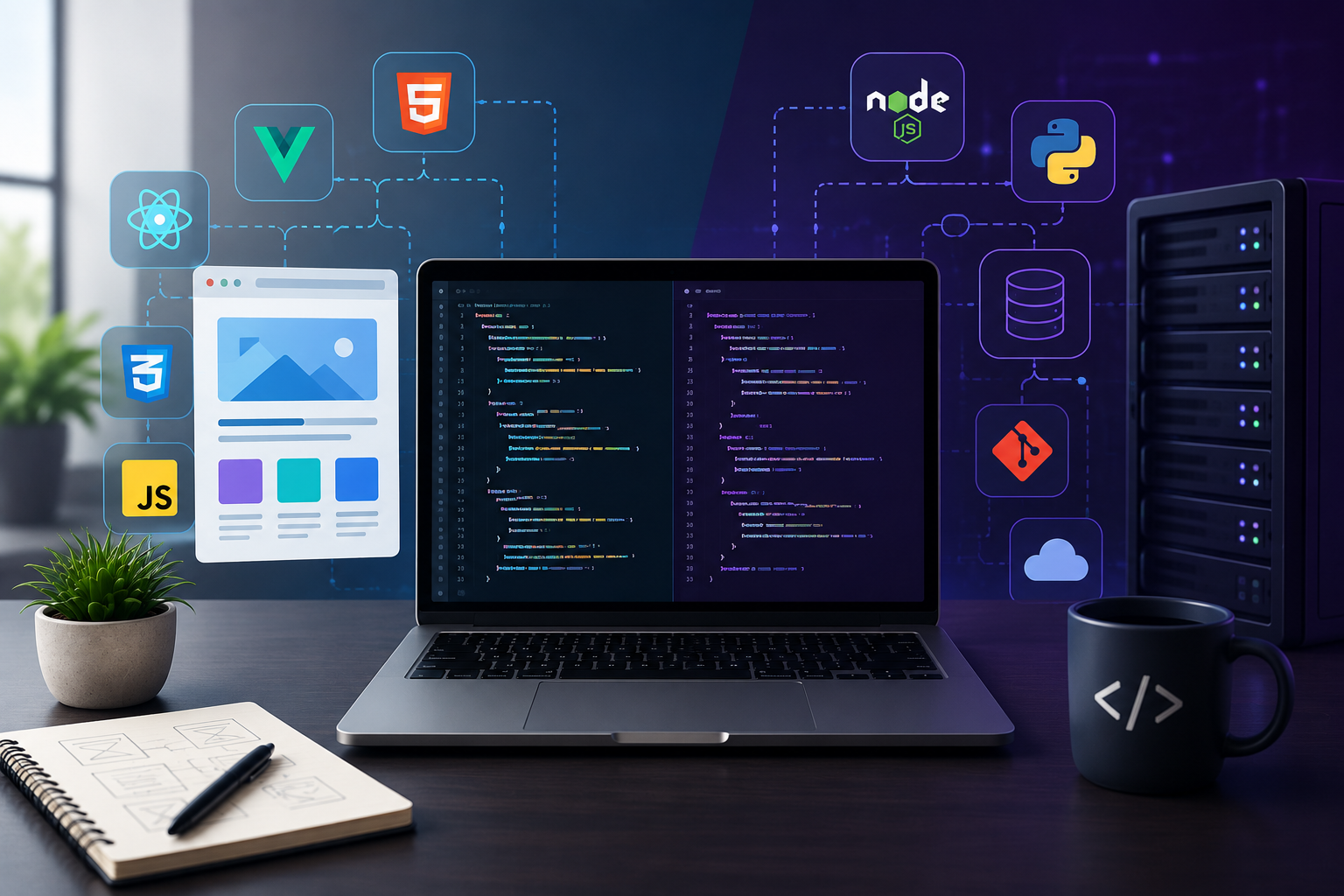
In software development, an application is typically divided into two main layers. The frontend is everything a user sees and interacts with directly: buttons, forms, images, animations, and the overall visual experience. The backend is the invisible engine running behind the scenes: databases, servers, application logic, and the infrastructure that processes requests and returns data.
A full stack developer is someone who can work competently across both of these layers. Rather than specializing exclusively in frontend design or backend architecture, full stack developers understand the entire technology stack, from the user interface all the way down to the database and server configuration.
This versatility is precisely why full stack development has become so valuable. Companies, particularly startups and mid-sized businesses, often cannot afford to hire separate frontend and backend specialists for every project. A skilled full stack developer can single-handedly build, test, and deploy a complete web application, dramatically reducing development time and communication overhead between teams.
The Core Technologies Behind Full Stack Development
Full stack development relies on a combination of technologies often referred to as a “stack.” Some of the most popular stacks in the United States today include:
The MERN Stack: MongoDB, Express.js, React, and Node.js. This JavaScript-based stack has become extremely popular because it allows developers to use a single programming language across the entire application.
The MEAN Stack: Similar to MERN but using Angular instead of React for the frontend framework. This is favored by enterprises that prefer Google-backed frameworks with strong typing support through TypeScript.
Python and Django: Popular for applications requiring rapid development, data science integration, or machine learning capabilities, with Django serving as a robust backend framework.
Ruby on Rails: Still widely used by startups for its convention-over-configuration philosophy that allows for extremely fast prototyping and development cycles.
Beyond programming languages and frameworks, full stack developers also need to understand databases (both SQL options like PostgreSQL and NoSQL options like MongoDB), version control systems like Git, cloud platforms like AWS or Azure, and increasingly, containerization tools like Docker and Kubernetes.
Why American Businesses Cannot Get Enough Full Stack Talent
The demand for full stack developers in the United States has consistently outpaced supply for several years running. According to industry hiring data, full stack development remains one of the top three most requested technical skills on job platforms nationwide.
Several factors drive this demand. First, the rise of agile development methodologies favors small, cross-functional teams where full stack capability allows for faster iteration. Second, the explosion of startups across the country means companies need lean engineering teams that can wear multiple hats. Third, even established enterprises are restructuring their engineering organizations around full stack pods rather than siloed frontend and backend teams.
Full Stack Development as a Career Path
For individuals considering a career in software engineering, full stack development offers one of the most flexible and resilient paths available. Full stack engineers typically command competitive salaries, often ranging significantly above the national average for technical roles, and they enjoy greater job security because their skill set applies across a wider range of company types and project needs.
Many full stack developers begin their careers specializing in either frontend or backend work before expanding their skill set. Others pursue full stack bootcamps or self-directed learning paths that compress years of traditional computer science education into months of intensive, project-based training.
Hiring Full Stack Developers: What Businesses Should Know
For business owners and hiring managers, understanding what makes a strong full stack developer is essential to building an effective engineering team. Look beyond technical skills alone. The best full stack developers also demonstrate strong problem-solving abilities, effective communication across departments, and a product-oriented mindset that considers the full user experience rather than isolated technical components.
Many businesses choose to work with established full stack development companies rather than hiring individual contractors or building an in-house team from scratch. This approach provides immediate access to a complete team of vetted engineers, project managers, and quality assurance specialists without the time and risk associated with individual hiring.
Getting Started With Full Stack Development
Whether you are looking to hire a full stack development partner or considering a career shift into this field, the fundamentals remain the same: understand both sides of the technology stack, stay current with evolving frameworks and tools, and prioritize building real, functional applications over purely theoretical knowledge.
Explore our directory of verified full stack development companies across the United States to find the right partner for your next software project, complete with contact information, specializations, and location details for firms in every major American tech hub.
Common Myths About Full Stack Development
Several misconceptions persist about what full stack development actually involves. One common myth suggests that full stack developers are simply “jacks of all trades, masters of none,” implying inferior expertise compared to specialists. In reality, many highly skilled full stack developers possess deep expertise in multiple areas simultaneously, having deliberately invested years building comprehensive technical knowledge across the stack.
Another misconception assumes full stack development means knowing every possible technology and framework available. In practice, most full stack developers specialize within a particular technology ecosystem, such as the JavaScript stack or the Python ecosystem, rather than attempting mastery across every possible language and tool combination.
How Full Stack Development Has Evolved Over Time
The concept of full stack development has transformed significantly over the past decade. Early full stack developers often worked with simpler technology stacks involving basic server-side scripting languages like PHP combined with straightforward HTML and CSS frontends. Today’s full stack developers navigate considerably more sophisticated environments involving cloud infrastructure, containerization, microservices architecture, and complex state management systems.
This evolution reflects the broader maturation of web and application development as an industry. As user expectations for performance, interactivity, and reliability have increased dramatically, the technical sophistication required to deliver competitive software products has grown correspondingly, raising the bar for what it means to be proficient across the full technology stack.