
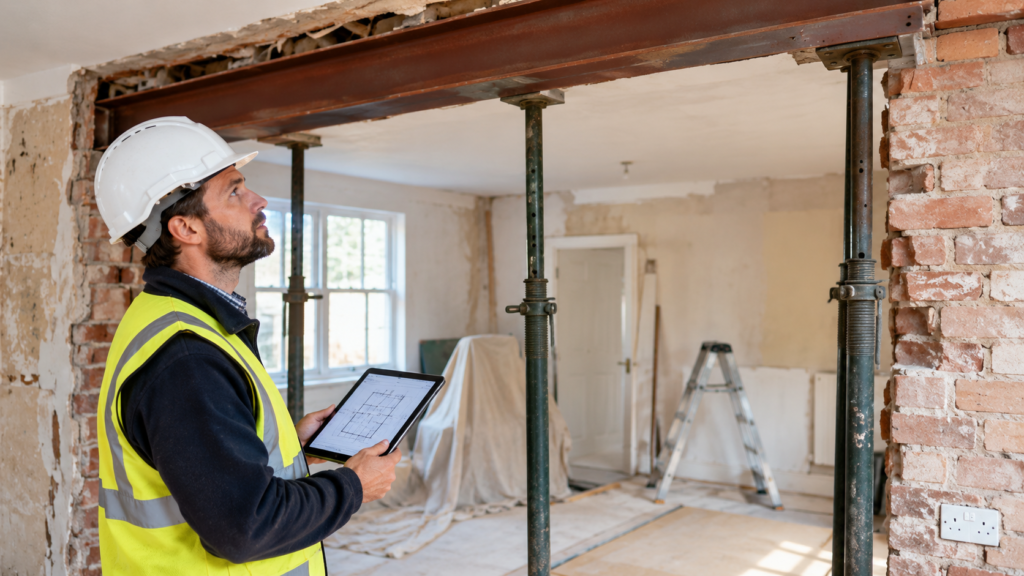
If you are planning to knock through a wall, convert a loft, or you have spotted a crack that keeps growing, one of the first questions you will ask is simple: what will a structural engineer cost?
The short answer is that most UK homeowners pay between £300 and £500 for a typical household job, such as checking a load-bearing wall and producing beam calculations. Hourly rates commonly sit between about £75 and £200, depending on where you live and how experienced the engineer is. Complex projects can run into the thousands.
Those numbers only tell part of the story, though. The final structural engineer cost depends on the type of job, your location, the size of your property, and what the fee actually includes. This guide uses 2026 figures from published UK cost guides to break down typical prices, show you what affects your quote, and explain how to keep the bill under control without cutting corners on safety.
Structural Engineer Cost at a Glance
The table below combines ranges from two of the most detailed UK guides published this year, the HomeOwners Alliance and MyJobQuote. They do not match exactly, so each range shows the overall spread. Treat it as a budgeting starting point, not a quote.
| Service | Typical UK price (2026) |
|---|---|
| Hourly rate | £75–£200 |
| Day rate | £400–£600 |
| Site inspection | £175–£600 |
| Structural report | £500–£2,000 |
| Beam or RSJ calculations | £300–£950 |
| Loft conversion structural design | £600–£2,200 |
| House extension structural design | £400–£2,200 |
| Chimney breast removal | £100–£500 |
| New door or window opening | £150–£500 |
| Roof check for solar panels | £150–£500 |
| Full structural design for a new house | £2,000–£5,000 |
| Complex projects | Up to £10,000 |
Always check whether a quote includes VAT, and whether site visits, drawings, and revisions are in the price. Two engineers can quote very different totals for what looks like the same job simply because one includes extras the other leaves out.
Structural Engineer Hourly Rate and Day Rate in the UK
Many engineers quote a fixed fee for domestic work, but hourly and day rates explain how that fee is built. For small household jobs, MyJobQuote reports hourly rates of roughly £75 to £125. The HomeOwners Alliance gives a wider range of £90 to £200 and puts the typical figure close to £100 an hour. For larger jobs, engineers more often work to a day rate of around £400 to £600.
Location moves the structural engineer cost more than almost anything else. Based on MyJobQuote’s regional data:
- London and the South East: roughly £90 to £150 per hour, or £500 to £700 per day.
- Major cities such as Manchester, Leeds, Birmingham, and Sheffield: roughly £75 to £130 per hour, or £450 to £600 per day.
- Smaller cities and large towns: roughly £65 to £115 per hour, or £400 to £550 per day.
- Rural areas: roughly £60 to £100 per hour, or £350 to £500 per day.
MyBuilder suggests engineers in London and the South East typically charge 20 to 40 percent more than those elsewhere. Different guides, different methods, same direction: expect to pay more in the capital.
Structural Engineer Cost by Job Type
Most homeowners do not pay by the hour. They pay a fixed fee for a defined job. Here is what to expect for the most common projects.
Removing a Load-Bearing Wall or Fitting an RSJ
This is the most common reason people hire a structural engineer. For a straightforward inspection and calculations, expect to pay around £300 to £500. If a steel beam (RSJ) is needed and the engineer has to produce detailed calculations and drawings, fees commonly rise to £450 to £900.
Remember that the engineer designs the beam. They do not supply or fit it. Installing the steel typically adds another £1,500 to £2,500 on top.
Loft Conversion
For a loft conversion, structural engineer fees usually fall between £600 and £2,200. The engineer inspects the existing roof and ceiling structure, measures spans and loads, and designs the new beams and supports. Dormers and roof alterations push the price toward the top of that range.
House Extension
Structural design for an extension typically costs £400 to £2,200, depending on size and complexity. The fee covers checking the existing structure and providing calculations for foundations, beams, walls, and roof elements. Building Control will usually want these calculations before approving the work. Your architect’s drawings are a separate cost.
Chimney Breast Removal
Removing a chimney breast usually costs £100 to £500 in engineering fees. The engineer works out how the remaining chimney above will be supported and calculates any steel needed to carry it.
New Door or Window Opening
Cutting a new opening in a load-bearing wall typically costs £150 to £500. The fee depends on whether a simple lintel will do or a larger steel support is required.
Roof Check for Solar Panels
Before installing solar panels, an engineer can confirm the roof structure can handle the extra weight and wind uplift. This check usually costs £150 to £500.
Inspections and Reports for Cracks or Subsidence
A basic inspection typically costs £175 to £600, and a written report £500 to £2,000. Widespread cracking or suspected subsidence takes longer to investigate, so those jobs sit at the higher end. These fees cover the engineer’s professional time only. They do not include any repair work the report recommends.
New-Build Houses
Full structural design for a new house, including foundations, floors, walls, beams, and roof supports, usually costs £2,000 to £5,000. Large or unusual designs can go well beyond that.
What Does a Structural Engineer’s Fee Include?
A typical domestic fee covers the initial site visit and inspection, basic structural calculations, standard drawings for straightforward work, and a short written summary where needed.
These items are often charged separately:
- Additional site visits
- Revised drawings if the design changes
- Detailed structural reports
- Liaison with architects, builders, or Building Control
The simplest way to avoid a nasty surprise is to ask for a fixed fee in writing and check that it includes responding to Building Control queries. A slightly higher fixed quote that covers everything often costs less than a cheap quote with extras.
Extra Costs Beyond the Engineer’s Fee
The structural engineer cost is rarely the whole bill. The engineer’s calculations often lead to other work and approvals. Typical extras include:
| Extra cost | Typical UK price |
|---|---|
| Installing an RSJ | £1,500–£2,500 |
| Minor remedial structural work | £300–£1,000 |
| Building Control fees | £200–£500 |
| Party wall surveyor (if a neighbour disputes or does not respond) | £700–£1,500 |
| New foundations | £4,000–£12,000 |
| Underpinning a house | £4,800–£36,500 |
| Extra consultations or revisions | £90–£120 per hour |
Planning permission is a separate matter. MyJobQuote lists the fee for a standard householder application in England at £528, although many smaller projects fall under permitted development and need no application. Fees change, so confirm current figures with your local authority.
Two official resources are worth reading before you start. The government’s guide to building regulations approval explains when approval is needed, and its Party Wall etc. Act guidance explains what to do if your work affects a shared wall.
What Affects Structural Engineer Cost?
Not every job is priced the same way. These factors move your quote up or down:
- Complexity. Checking one beam costs far less than redesigning a loft that involves a chimney breast.
- Location. London and the South East cost more than most other regions.
- Property size. Inspecting a one-bedroom flat is simpler than assessing a large detached house.
- Access. Steep roofs or cramped spaces take longer and can add to the fee.
- Qualifications. Members of professional bodies such as the Institution of Structural Engineers or the Institution of Civil Engineers, and chartered engineers, may charge more.
- Urgency. Same-day visits and out-of-hours work usually carry a premium.
- Third-party coordination. Time spent liaising with architects, builders, or Building Control may be billed on top.
- Company size. An independent engineer and a large practice may price the same job differently, so compare both.
How Long Does a Structural Engineer Take?
Most domestic site visits take a few hours. For simple jobs such as checking one wall, calculations are usually issued within a few working days. Loft conversions and extensions involve more drawings and revisions, so allow longer. A new-build design can need several days of engineering time.
Plan for this early. Builders often cannot start until Building Control has approved the calculations, so a delay at the engineering stage can hold up the whole project.
Structural Engineer, Architect, or Surveyor: Who Do You Need?
People often mix these three up, and hiring the wrong one wastes money.
- Structural engineer. Checks whether changes are safe, and produces the calculations and drawings Building Control needs. You need one whenever work affects walls, roofs, foundations, or other load-bearing parts.
- Architect. Designs the layout, appearance, and use of space. You usually need one for an extension or new build, but not for simply removing a load-bearing wall.
- Surveyor. A chartered surveyor assesses the overall condition of a property. An engineer inspection, by contrast, focuses only on structural concerns such as cracks and movement. If you are specifically looking for surveying services, that is a separate category.
For most larger projects, you will need the architect and the engineer working together. For a single beam or wall removal, the engineer alone is usually enough. The HomeOwners Alliance also has a helpful guide on whether you need a structural engineer.
How to Cut Your Structural Engineer Cost
You can reduce the bill without compromising safety. Try these steps:
- Simplify the design. Clean, square lines are cheaper to engineer than curves and awkward angles, as the HomeOwners Alliance points out.
- Give the engineer everything upfront. Photos, existing drawings, and planning details reduce site time and make quotes more accurate.
- Get at least three quotes. Make sure each one covers the same scope so you are comparing like with like.
- Ask for a fixed fee. Hourly billing is harder to control on open-ended jobs.
- Bundle the work. If you need a wall removed and a loft converted, one engineer handling both is usually cheaper than two separate visits.
- Hire locally. Travel time costs money, and local engineers know their Building Control office.
- Avoid doing it twice. Getting calculations after the work is done is possible, but opening up finished work and revising designs often costs more than doing it right the first time.
How to Hire the Right Structural Engineer
Hiring an engineer is different from hiring a tradesperson. You are paying for professional judgement and liability, so check these points before you commit:
- Professional membership. Look for membership of the Institution of Structural Engineers or the Institution of Civil Engineers.
- Chartered status. For complex or higher-risk projects, a chartered engineer is the safer choice. For simple domestic jobs, an experienced engineer working under a chartered supervisor can be suitable.
- Relevant experience. Ask for similar residential projects, not just commercial or industrial work.
- Professional indemnity insurance. This is essential. Ask for proof of the cover level on bigger projects.
- A clear quote. Confirm what is included, how revisions are handled, and when you will receive the calculations.
- Reviews and samples. Ask to see sample drawings or reports, and check past client feedback.
Our guide on how to hire a structural engineering firm goes deeper on vetting engineers and comparing proposals.
Find a Structural Engineer in the UK
Searching engines for engineers can leave you comparing dozens of websites. A directory puts location, specialty, and contact details in one place.
Engineers Mirror lists 146 companies across the United Kingdom and 93 under Structural Design, at the time of writing. If you are based in the capital, you can browse engineering companies in London. A few UK structural practices recently added to the directory include T. White Structural Services Limited and Abott Structural Engineering Ltd in Bolton, MC Structural Engineers Ltd in Dobcross, and Structural Engineer UK and Structural Engineer Calcs Ltd in Manchester. A directory listing is not an endorsement, so always verify credentials, insurance, and references before you hire.
Prefer to send one brief and let engineers come to you? Use the project form on the Engineers Mirror homepage. It is free for buyers, and providers reply to you directly.
If you are an engineer yourself, you can list your company for free and get found by homeowners and developers searching for exactly your services. For more buying advice, browse our engineering guides.
Final Thoughts on Structural Engineer Cost
The structural engineer cost for most UK homes is a small slice of the overall project budget, yet it protects the largest investment you own. A £300 to £500 fee for checking a load-bearing wall is cheap insurance against a collapsed ceiling or a failed Building Control inspection.
Know the typical ranges, expect to pay more in London and the South East, and always ask what is included. Get three like-for-like quotes, choose an insured and properly qualified engineer, and budget for the extras that follow, from steelwork to Building Control fees. Do that and you will avoid most of the nasty surprises.
Ready to compare engineers? Browse UK structural engineering companies on Engineers Mirror, or send one project brief and let the right providers come to you.
Frequently Asked Questions
How much does a structural engineer charge per hour in the UK?
Most UK structural engineers charge roughly £75 to £200 per hour in 2026, with many guides putting the typical figure near £100. Rates are higher in London and the South East, and lower in rural areas. Many domestic jobs are quoted as a fixed fee instead.
How much do RSJ calculations cost?
Calculations for a straightforward wall removal commonly cost £300 to £500. When detailed calculations and drawings are needed for a steel beam, expect around £450 to £900. This does not include supplying or fitting the beam, which typically adds £1,500 to £2,500.
Do I legally need a structural engineer to remove a wall?
A structural engineer is not legally required for every project, but Building Control will usually ask for structural calculations when work affects a load-bearing wall. If the wall is only a partition, you may not need one. An engineer can confirm which type of wall you have.
How much does a structural engineer cost in London?
Expect to pay more in London and the South East. MyJobQuote data suggests roughly £90 to £150 per hour and £500 to £700 per day, while MyBuilder puts the premium at around 20 to 40 percent above other regions.
How long does it take to get structural calculations?
For simple jobs, calculations are usually issued within a few working days of the site visit. Loft conversions, extensions, and new builds take longer because they involve more drawings and revisions. Ask for a delivery date before you commit.
Can I get structural calculations for work that is already finished?
Yes. An engineer can inspect completed work and produce calculations after the fact, which may be needed if Building Control or a solicitor asks for proof that the work is safe. It is usually more expensive than arranging calculations before work starts.
Looking for engineering companies?
Compare 809 verified engineering companies on Engineers Mirror and contact them directly.