
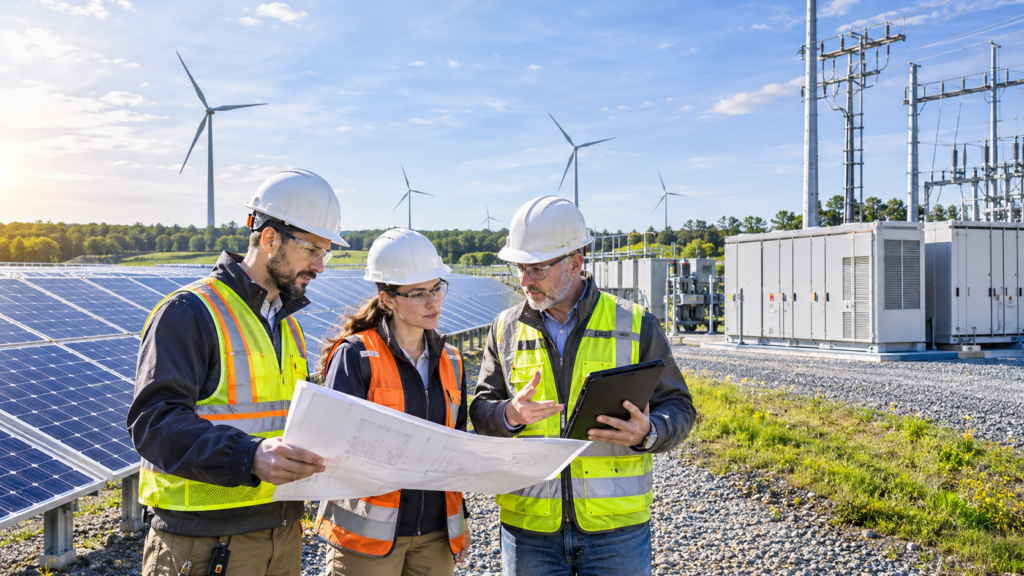
Renewable energy engineering services help businesses, developers, utilities, and industrial organizations plan, design, develop, and operate energy systems powered by naturally replenishing resources.
Installing solar panels or purchasing wind turbines is only one part of developing a successful renewable energy project. Behind every installation is a considerable amount of technical planning, engineering analysis, equipment selection, infrastructure design, and regulatory coordination.
Imagine a manufacturing company planning to install a large rooftop solar system to reduce its dependence on grid electricity. The available roof space appears sufficient, and the proposed equipment meets the company’s budget.
However, several important questions remain.
Can the existing roof support the additional loads? How much electricity will the system actually generate? Can the existing electrical infrastructure accommodate the new installation? Will the utility approve the proposed grid connection?
Renewable energy engineers help investigate these questions before the company commits to construction.
This guide explains the different types of renewable energy engineering services, their applications, project development stages, engineering deliverables, costs, and the considerations involved in developing reliable clean energy infrastructure.
If you are looking for a technical partner, explore the Renewable Energy Companies directory on Engineers Mirror.
What Are Renewable Energy Engineering Services?
Renewable energy engineering services are professional technical services that support the development and operation of systems using renewable energy resources.
These resources include sunlight, wind, flowing water, geothermal heat, and sustainably sourced biomass.
The engineering scope may involve feasibility studies, resource assessments, energy production modeling, system design, electrical infrastructure, structural analysis, equipment specifications, and commissioning support.
Battery energy storage and microgrid engineering are also frequently included in renewable energy projects because they can help manage electricity generation, consumption, and system reliability.
Battery storage itself is not a renewable energy source. Its environmental and operational benefits depend partly on how electricity is generated, stored, and used.
The primary objective of renewable energy engineering is to develop systems that satisfy defined technical, safety, operational, environmental, and commercial requirements.
Looking for engineering companies?
Compare 866 verified engineering companies on Engineers Mirror and contact them directly.
Why Renewable Energy Engineering Is Important
A renewable energy system needs to perform within real-world conditions rather than simply meet its theoretical equipment specifications.
A solar installation, for example, may experience shading, elevated operating temperatures, equipment degradation, electrical losses, and weather-related limitations.
A wind energy project depends on local wind conditions, turbine performance, site accessibility, foundation requirements, and electrical infrastructure.
Engineering helps developers evaluate these factors and make better-informed project decisions.
Properly scoped renewable energy engineering services can support:
- More realistic energy production estimates
- Appropriate equipment and technology selection
- Improved system reliability
- Identification of technical and site constraints
- Electrical and structural design coordination
- Regulatory and utility approval processes
- Construction planning and procurement
- Long-term maintenance strategies
- Evaluation of potential project risks
Professional engineering does not eliminate every project risk. However, it provides a structured process for identifying and addressing technical challenges before they become more expensive to resolve.
10 Major Types of Renewable Energy Engineering Services
1. Solar Energy Engineering Services
Solar engineering is concerned with the development of systems that convert sunlight into usable energy.
Solar photovoltaic systems generate electricity, while solar thermal technologies use captured solar heat for suitable applications.
Solar photovoltaic engineering services commonly include:
- Solar resource assessment
- Rooftop and ground-mounted system design
- Module and inverter selection
- Shading analysis
- Electrical system design
- Structural and mounting coordination
- Energy production modeling
- Monitoring system specifications
- Utility interconnection support
A commercial rooftop project may require engineers to coordinate structural capacity, electrical distribution, fire access, equipment locations, and maintenance access.
A utility-scale solar development may involve extensive civil engineering, environmental studies, medium-voltage collection systems, substations, and transmission infrastructure.
The U.S. Department of Energy’s guide to photovoltaic system design explains the major technologies and supporting components involved in solar electricity generation.
2. Wind Energy Engineering Services
Wind energy engineering supports the development of systems that convert wind into electrical energy.
Wind engineering projects can range from distributed installations supporting individual facilities to large onshore and offshore wind farms.
Typical services include wind resource assessment, turbine selection, site layout development, foundation engineering, electrical collection system design, and energy yield analysis.
Wind turbine performance depends on more than its rated generating capacity.
The wind resource, turbine operating characteristics, turbulence, surrounding terrain, wake effects, and equipment availability can all influence annual electricity generation.
Engineers must also consider transportation logistics, construction access, maintenance requirements, environmental constraints, and the electrical connection to the grid.
Offshore wind projects require additional specialist knowledge involving marine environments, offshore foundations, submarine cables, and installation operations.
3. Battery Energy Storage System Engineering
Battery energy storage systems, commonly referred to as BESS, store electrical energy for use at another time.
Energy storage can support renewable energy projects by shifting electricity consumption, managing peak demand, providing selected grid services, or supplying backup power when appropriately designed.
Battery storage engineering involves more than selecting a battery with sufficient capacity.
The engineering team must consider power requirements, usable energy capacity, operating strategy, battery degradation, electrical protection, thermal management, equipment placement, and safety requirements.
A typical BESS engineering scope may include:
- Power and energy capacity assessment
- Battery technology evaluation
- Power conversion system specifications
- Electrical protection design
- Energy management system integration
- Thermal management coordination
- Fire safety and emergency response planning
- Commissioning and performance testing
The Department of Energy’s battery energy storage procurement checklist provides a useful reference for planning commercial-scale storage projects.
Battery system design and installation should be undertaken by qualified professionals familiar with the applicable technology and safety requirements.
4. Hydropower Engineering Services
Hydropower systems generate electricity by using energy associated with moving water.
Engineering services may support conventional hydropower facilities, small hydropower developments, upgrades to existing generating infrastructure, and pumped storage projects.
Typical engineering activities include hydrological assessment, hydraulic modeling, turbine selection, civil infrastructure design, mechanical equipment engineering, and electrical power generation systems.
Project feasibility depends on factors such as available water flow, hydraulic head, environmental obligations, infrastructure conditions, and electricity demand.
Pumped storage hydropower primarily serves as an energy storage technology. It uses electricity to move water to a higher elevation and later recovers part of that energy through generation.
Hydropower projects require careful evaluation of potential environmental and community impacts.
5. Geothermal Energy Engineering Services
Geothermal engineering involves using naturally occurring heat from beneath the Earth’s surface.
Applications may include geothermal electricity generation, direct heating, industrial heat applications, and ground-source heat pump systems.
These applications differ considerably in their technical requirements.
A ground-source heat pump installation generally requires thermal analysis, ground-loop design, building load assessments, and mechanical system coordination.
A geothermal power generation project may require geological investigation, reservoir assessment, drilling engineering, fluid handling infrastructure, and power conversion equipment.
The suitability of a geothermal project depends on the local resource, ground conditions, project objectives, and available infrastructure.
6. Biomass and Bioenergy Engineering
Bioenergy engineering supports systems that use biological materials to produce heat, electricity, or fuels.
Potential feedstocks include agricultural residues, organic waste, forestry byproducts, and other suitable biological materials.
Engineering services may involve feedstock assessment, combustion systems, anaerobic digestion, biogas processing, heat recovery, power generation, and environmental control systems.
Unlike solar and wind facilities, many bioenergy projects depend on a continuing supply of suitable feedstock.
The engineering and development process therefore needs to consider material availability, transportation, storage, process efficiency, emissions, waste management, and operating costs.
Whether a particular bioenergy system delivers meaningful environmental benefits depends on its feedstock sourcing, conversion process, emissions, and overall lifecycle impacts.
7. Hybrid Renewable Energy and Microgrid Engineering
Hybrid energy systems combine two or more energy technologies to meet defined electricity or heating requirements.
For example, an industrial facility may combine solar photovoltaic generation, battery storage, grid electricity, and an existing backup generator.
A microgrid is a coordinated electrical system serving a defined group of loads and energy resources. Depending on its design, it may operate while connected to the wider electrical grid and may also support independent operation.
Microgrid engineering requires coordination between generation equipment, storage systems, electrical protection, control strategies, and electricity demand.
The Department of Energy’s Microgrid System Project Development Checklist offers a useful planning reference for commercial-scale projects.
A hybrid system should be designed according to its actual operating objectives. Reducing electricity costs, supporting critical loads, and operating independently during outages require different technical considerations.
8. Renewable Energy Grid Integration Services
Connecting a renewable energy installation to an electrical grid requires careful coordination between the generating system, electrical infrastructure, and network operator.
Depending on the project, grid integration services may include:
- Load flow studies
- Short-circuit analysis
- Protection coordination
- Power quality assessment
- Electrical equipment specifications
- Substation engineering
- Interconnection documentation
- Utility technical coordination
- Grid compliance studies
For smaller distributed energy projects, existing distribution infrastructure may be sufficient, subject to utility requirements.
Larger developments may require dedicated substations, network upgrades, or additional transmission studies.
The complexity and cost of grid connection can significantly influence overall project feasibility.
For projects involving broader electrical infrastructure requirements, read our guide to hiring an electrical engineering consultant.
9. Renewable Energy Feasibility Studies
A feasibility study investigates whether a proposed renewable energy project is technically and commercially practical under defined assumptions.
Instead of immediately developing detailed engineering drawings, the consultant first evaluates the available resource, project objectives, site conditions, infrastructure requirements, and potential development constraints.
A feasibility study may include:
- Preliminary resource assessment
- Technology comparison
- Site suitability evaluation
- Estimated generating capacity
- Expected energy production
- Preliminary equipment requirements
- Grid connection considerations
- Initial capital and operating cost estimates
- Development risk assessment
A feasibility study is especially valuable when a business is considering several technologies or potential development locations.
Its conclusions can help project owners determine whether additional investigations and detailed engineering are justified.
10. Commissioning and Performance Engineering
Commissioning is the process of evaluating whether installed equipment and systems meet agreed technical and functional requirements.
Renewable energy commissioning may include reviewing installation documentation, inspecting completed work, verifying functional performance, reviewing protection and control systems, and documenting acceptance results.
Performance engineering continues after installation where included in the service agreement.
Engineers may review operating data, investigate discrepancies between predicted and actual generation, assess system availability, or identify equipment performance issues.
These services can help owners make informed maintenance and optimization decisions throughout the asset’s operational life.
How Renewable Energy Engineering Services Work
Renewable energy projects typically progress through several technical development stages.
The exact process depends on the technology, project size, procurement model, location, and applicable regulations.
Stage 1: Define Project Objectives
The first stage establishes what the project is intended to achieve.
A manufacturing company may want to reduce purchased electricity. A commercial property operator may want to improve resilience. A renewable energy developer may intend to supply electricity to the grid under a commercial agreement.
The project objectives influence technology selection, energy capacity, system configuration, and operating strategy.
Stage 2: Resource and Site Assessment
Engineers investigate the conditions affecting the proposed energy system.
For solar projects, this may include sunlight availability, shading, roof conditions, land availability, and electrical infrastructure.
For wind developments, resource measurements, terrain, site access, and environmental constraints may be more important.
Existing surveys, utility information, electricity consumption records, and weather data can support the assessment.
Additional investigations may be necessary before reliable engineering conclusions can be reached.
Stage 3: Technical Feasibility and Concept Design
The engineering team develops preliminary options and evaluates their suitability.
This stage may compare different generating technologies, equipment configurations, installation arrangements, storage capacities, and grid connection strategies.
The owner can use these findings to decide whether to proceed and which concept requires further development.
Stage 4: Detailed Engineering Design
Once a suitable concept has been selected, engineers develop the technical documentation required for procurement, approval, and construction.
Detailed engineering may include electrical drawings, civil plans, structural calculations, equipment specifications, protection studies, control system requirements, and other discipline-specific documents.
Design reviews help identify conflicts between the different engineering disciplines.
Stage 5: Permitting and Interconnection Coordination
The relevant authorities and electricity network operator may require technical submissions before construction or grid connection.
The engineering team can prepare supporting documentation and respond to technical review comments where included in its scope.
Approval responsibilities, application fees, and required third-party studies should be identified clearly.
Engineering support does not guarantee that an authority or utility will approve a project.
Stage 6: Procurement and Construction Support
Engineering consultants may assist with technical equipment specifications, supplier proposal reviews, contractor questions, and construction-related design changes.
Clearly defined specifications help ensure that supplied equipment is compatible with the approved system design.
Where construction monitoring or inspection is needed, the contract should establish its frequency and purpose.
Stage 7: Commissioning and System Handover
After installation, the project moves into its testing and acceptance phase.
Relevant systems are evaluated against agreed requirements by appropriately qualified personnel.
The owner should receive the agreed documentation, including final drawings, operating instructions, equipment information, and commissioning records.
Stage 8: Operations and Lifecycle Support
Renewable energy assets require ongoing maintenance and performance evaluation.
Operating data can help owners identify underperformance, equipment failures, changing energy demand, and maintenance priorities.
Lifecycle planning may also address equipment replacement, battery augmentation, system upgrades, repowering, and eventual decommissioning.
Renewable Energy Engineering Deliverables
A professional engineering proposal should clearly identify the documents, models, calculations, and technical services the project owner will receive.
| Engineering deliverable | Purpose |
|---|---|
| Feasibility study | Evaluates preliminary project viability |
| Resource assessment | Characterizes available renewable energy resources |
| Energy yield report | Estimates electricity production under defined assumptions |
| Concept design | Establishes the preliminary technical configuration |
| Site layout | Defines equipment arrangements and infrastructure locations |
| Electrical single-line diagram | Documents electrical system architecture |
| Structural calculations | Supports applicable structural design decisions |
| Equipment specifications | Defines technical procurement requirements |
| Grid interconnection study | Evaluates selected network connection requirements |
| Risk assessment | Identifies technical and operational concerns |
| Construction drawings | Provides agreed installation and construction details |
| Commissioning plan | Establishes applicable testing and acceptance requirements |
| As-built documentation | Records the final installed configuration |
| Operations and maintenance documentation | Supports long-term asset management |
Not every project requires all these deliverables.
A preliminary solar feasibility study will have a substantially different scope from the detailed engineering package for a utility-scale renewable energy development.
Understanding Renewable Energy Capacity and Energy Production
One of the most important distinctions in renewable energy engineering is the difference between power capacity and energy production.
Power is commonly measured in kilowatts or megawatts.
Energy is commonly measured in kilowatt-hours or megawatt-hours.
A generating facility rated at one megawatt does not necessarily generate one megawatt continuously throughout the year.
Actual energy production depends on resource availability, equipment performance, operating conditions, and system losses.
Illustrative Solar Energy Production Example
Consider a hypothetical solar facility with the following assumptions:
| Parameter | Illustrative value |
|---|---|
| Installed solar capacity | 1,000 kWp DC |
| Annual specific energy yield | 1,500 kWh per kWp |
| Estimated annual electricity generation | 1,500,000 kWh |
| Equivalent annual generation | 1,500 MWh |
The estimated annual generation is calculated by multiplying the installed DC capacity by the assumed annual specific energy yield.
This example demonstrates the calculation method. It does not represent a verified production forecast for a particular location.
An actual solar energy model must account for the local resource, system configuration, temperature, shading, electrical losses, equipment characteristics, curtailment, and other relevant limitations.
The Department of Energy’s photovoltaic energy yield resources provide additional information about factors affecting real-world solar energy production.
Understanding Battery Power and Energy Capacity
Battery systems are commonly described using both power and energy ratings.
For example, a hypothetical battery system rated at 500 kW and 2,000 kWh has a nominal four-hour duration when delivering its rated power, assuming the full stated energy capacity is available.
Actual operating duration depends on usable capacity, battery management settings, conversion losses, operating limits, and system conditions.
This distinction matters when a business is evaluating backup power requirements or electricity demand management.
An energy storage system should be sized according to its intended operating strategy rather than nominal capacity alone.
Renewable Energy Engineering Services by Industry
Different industries have different electricity requirements, operational constraints, and sustainability objectives.
| Industry | Typical renewable energy applications |
|---|---|
| Manufacturing | Solar power, storage and industrial energy integration |
| Commercial real estate | Rooftop solar and building energy systems |
| Data centers | Renewable electricity procurement and resilience systems |
| Agriculture | Solar irrigation, bioenergy and distributed generation |
| Warehousing | Rooftop solar and electricity demand management |
| Healthcare | Energy resilience and critical power coordination |
| Hospitality | On-site generation and energy efficiency integration |
| Education | Campus solar installations and microgrids |
| Utilities | Utility-scale generation, storage and grid integration |
| Municipal infrastructure | Distributed generation and public facility energy systems |
| Remote industrial facilities | Hybrid energy systems and isolated power networks |
The appropriate technology depends on more than industry type.
A facility’s electricity consumption patterns, available infrastructure, operating schedule, and project location should guide the engineering assessment.
Grid-Connected vs Off-Grid vs Hybrid Renewable Energy Systems
Understanding the intended operating configuration is important when planning renewable energy infrastructure.
| System type | Main characteristics | Typical application |
|---|---|---|
| Grid-connected | Operates in coordination with the electricity network | Commercial properties and utility-scale projects |
| Off-grid | Supplies loads independently of the public electricity network | Remote facilities and isolated communities |
| Hybrid | Combines multiple energy resources or storage technologies | Industrial facilities and resilience projects |
A grid-connected solar system does not automatically provide electricity during a grid outage.
Backup operation requires equipment and system controls specifically designed for that function.
An off-grid system must accommodate periods when renewable generation is insufficient to meet demand.
Hybrid systems can provide greater operating flexibility, but their performance depends on appropriate equipment sizing, control strategies, and engineering coordination.
Renewable Energy Engineering Standards and Regulatory Requirements
Renewable energy projects may be subject to electrical, structural, environmental, fire safety, utility, and professional engineering requirements.
In the United States, relevant requirements may involve the National Electrical Code, locally adopted building and fire codes, equipment certification requirements, utility interconnection rules, and professional engineering licensing regulations.
For distributed energy resources, IEEE 1547-2018 is an important technical reference concerning interconnection with electrical distribution systems.
It should not be assumed that the same interconnection standard applies identically to every utility-scale transmission-connected development.
Applicable requirements depend on the connection voltage, network operator, technology, and jurisdiction.
Battery energy storage installations may require additional fire protection and emergency planning considerations.
Wind, hydropower, geothermal, and bioenergy projects may also involve technology-specific environmental and development approvals.
The engineering team should establish the applicable requirements, adopted code editions, technical standards, and approval responsibilities during project planning.
International projects must follow the regulations and professional practice requirements of their respective locations.
Renewable Energy Engineering vs EPC Services
When planning a renewable energy project, businesses may encounter engineering consultants and EPC contractors.
EPC stands for engineering, procurement, and construction.
An independent engineering consultant typically provides defined technical design, analysis, advisory, and review services.
An EPC contractor may take responsibility for a broader package involving engineering, equipment procurement, installation, and construction under a single contract.
| Consideration | Engineering consultant | EPC contractor |
|---|---|---|
| Technical feasibility | Frequently available | Depends on arrangement |
| Detailed engineering | Core service when contracted | Typically included in EPC scope |
| Equipment procurement | May provide advisory support | Typically included |
| Construction | Usually not directly performed | Typically managed or performed |
| Independent technical review | May be provided | Requires consideration of independence |
| Project delivery responsibility | Defined engineering responsibilities | Broader contractual delivery responsibilities |
| Commissioning | May review or support | Often included according to contract |
Some project owners appoint an independent owner’s engineer to review technical proposals, evaluate design decisions, and monitor agreed project requirements.
Neither procurement model is universally preferable. The appropriate arrangement depends on project complexity, internal resources, commercial objectives, and the allocation of responsibilities and risks.
How Much Do Renewable Energy Engineering Services Cost?
There is no universal engineering fee for renewable energy projects.
A straightforward commercial solar design assignment requires a different level of technical effort from a large wind development or a complex battery storage installation.
Engineering fees vary according to the scope of services and the investigations necessary to develop a suitable design.
Factors That Affect Renewable Energy Engineering Costs
Important cost factors include:
- Technology type and generating capacity
- Project location and site accessibility
- Availability of existing technical documentation
- Resource assessment requirements
- Structural and civil engineering complexity
- Electrical system and grid connection requirements
- Environmental and regulatory studies
- Equipment integration
- Energy production modeling
- Construction and commissioning support
- Number of design revisions
- Professional licensing requirements
Engineering consultants may charge fixed fees, hourly rates, milestone-based fees, or phased professional service fees.
Illustrative Engineering Budget Breakdown
Consider a hypothetical commercial solar engineering assignment.
| Engineering activity | Example fee |
|---|---|
| Preliminary site assessment | $2,000 |
| Feasibility and energy modeling | $3,500 |
| Electrical engineering design | $5,000 |
| Structural engineering coordination | $3,000 |
| Interconnection documentation | $2,500 |
| Defined commissioning support | $2,000 |
| Total illustrative engineering fee | $18,000 |
These figures are hypothetical and are intended only to demonstrate how engineering costs can be divided into separate work packages.
They are not verified market rates or an estimate for a specific project.
Equipment, installation, utility fees, third-party technical investigations, financing, and other development expenses are excluded from this example.
Before requesting quotations, use the Engineers Mirror Engineering RFQ Template to organize your requirements and obtain more comparable proposals.
How Renewable Energy Engineering Affects Project Economics
Renewable energy projects are often evaluated according to their expected electricity production, installation costs, operating expenses, and long-term economic performance.
Engineering provides technical inputs for these evaluations.
Important considerations include capital expenditure, equipment performance, maintenance requirements, annual energy production, degradation, electricity consumption patterns, and system availability.
For a commercial solar project, electricity generation that directly replaces purchased electricity may have a different economic value from generation exported to the grid.
Battery storage economics may depend on when stored electricity is discharged, the applicable electricity tariff, cycling limitations, equipment degradation, and the available commercial arrangements.
A reliable economic assessment should use realistic engineering assumptions rather than relying only on equipment ratings or optimistic energy savings estimates.
Financial feasibility should be evaluated using the actual project data and appropriate commercial expertise.
Common Challenges in Renewable Energy Projects
Overestimating Energy Production
A model that ignores realistic system losses, weather variation, equipment limitations, or operational restrictions can produce misleading generation forecasts.
Energy yield assumptions should be documented and reviewed.
Underestimating Grid Connection Requirements
A technically suitable renewable energy site may still face grid capacity limitations, additional studies, or expensive network upgrades.
Interconnection requirements should be investigated during the early development stages.
Inadequate Structural and Civil Engineering
Solar mounting systems, wind turbine foundations, equipment platforms, and access infrastructure require engineering appropriate to their site conditions.
Ignoring structural or civil requirements can lead to redesigns and construction complications.
Incorrect Energy Storage Sizing
A battery system selected without understanding electricity demand and operating objectives may not deliver the intended operational benefits.
Storage capacity, power rating, controls, and usable energy should be evaluated together.
Poor Coordination Between Engineering Disciplines
Renewable energy projects frequently involve electrical, mechanical, civil, structural, environmental, and control system engineers.
Unclear responsibilities can create design conflicts or gaps in technical documentation.
Ignoring Long-Term Maintenance
Equipment access, monitoring capabilities, replacement arrangements, and maintenance requirements should be considered during design.
A system that is difficult to maintain may become more expensive to operate over its lifetime.
How to Choose the Right Renewable Energy Engineering Company
Start by selecting a company with experience in the technology and project scale you require.
A firm specializing in residential rooftop solar may not have the resources necessary for a large wind farm or complex industrial microgrid.
Before hiring, verify the proposed team’s relevant engineering qualifications, comparable project experience, technical analysis capabilities, and understanding of local regulatory requirements.
Review the proposed deliverables, design assumptions, exclusions, schedule, insurance arrangements, and construction-phase responsibilities.
For regulated professional services, confirm the required engineering licenses through the relevant licensing authority.
Ask how the consultant will evaluate performance assumptions and document engineering decisions.
For a more detailed hiring checklist, interview questions, and provider evaluation guidance, read our existing article on how to choose a renewable energy engineering consultant.
Emerging Areas in Renewable Energy Engineering
Renewable energy engineering continues to develop alongside changing electricity demand, energy technologies, and grid requirements.
Several important areas of engineering activity include:
Solar and Storage Integration
Integrating solar generation with energy storage requires coordinated design of generating equipment, battery systems, electrical infrastructure, and operational controls.
Grid-Forming Inverter Technologies
Grid-forming inverters are designed to establish or support voltage and frequency behavior under specified operating conditions.
Their application requires careful consideration of system architecture, control strategies, and grid requirements.
Advanced Energy Management Systems
Digital energy management platforms can coordinate electricity consumption, renewable generation, battery operation, and selected grid interactions.
Their performance depends on appropriate system integration, data quality, and operational objectives.
Repowering and Asset Modernization
Existing renewable energy facilities may require upgraded equipment, revised control systems, additional generation capacity, or replacement of aging components.
Engineering assessments help owners evaluate whether these changes are technically and economically practical.
Weather Resilience and Lifecycle Engineering
Renewable energy facilities can face hazards involving extreme temperatures, flooding, wind, hail, and other environmental conditions.
Design teams increasingly need to consider suitable equipment, site conditions, maintenance access, and resilience objectives throughout the asset lifecycle.
Where to Find Renewable Energy Engineering Services
Engineers Mirror is a specialist B2B directory designed to help businesses discover and compare engineering companies, technical consultants, manufacturers, and industrial service providers.
Its Renewable Energy category displayed 85 company listings when reviewed on November 25, 2026.
These listings include different types of renewable energy businesses across multiple geographic markets, not exclusively independent engineering consultancies.
To identify suitable providers, visit the Renewable Energy Companies directory.
Review company profiles according to your required technology, service location, and technical capabilities.
Clearly describe your project objectives when contacting potential engineering partners.
Confirm whether the provider can support feasibility studies, system design, technical analysis, equipment specifications, interconnection coordination, or other services relevant to your project.
You can also visit the Engineers Mirror homepage to submit your project requirements and request connections with potentially suitable providers.
Always independently verify the qualifications and capabilities of individual companies before hiring.
Frequently Asked Questions
What are renewable energy engineering services?
Renewable energy engineering services include technical planning, feasibility studies, system design, engineering analysis, equipment specifications, grid integration, and commissioning support for renewable energy projects.
What does a renewable energy engineer do?
A renewable energy engineer evaluates energy resources, develops technical designs, analyzes system performance, coordinates engineering requirements, and supports the development or operation of renewable energy infrastructure.
Which renewable energy technologies require engineering services?
Solar photovoltaic systems, wind turbines, hydropower, geothermal systems, and bioenergy facilities may require engineering services. Related battery storage and hybrid microgrid systems also require appropriate technical design.
How much do renewable energy engineering services cost?
Costs depend on technology, project capacity, site conditions, technical complexity, engineering deliverables, regulatory requirements, and project schedule. Request a detailed project-specific proposal for a reliable estimate.
What is a renewable energy feasibility study?
A feasibility study evaluates whether a proposed renewable energy project is technically and commercially practical under defined assumptions. It may assess resource availability, site conditions, technology options, energy production, costs, and development constraints.
Can solar panels provide power during a grid outage?
Not automatically. A solar installation must have equipment and controls specifically designed for backup operation. Depending on system requirements, battery storage or another suitable power source may also be necessary.
Is battery storage a renewable energy source?
No. Batteries store electricity rather than generate renewable energy. Their role in renewable energy projects is to help manage electricity availability, consumption, and system operation.
What is the difference between renewable energy engineering and EPC?
Renewable energy engineering focuses on technical planning, analysis, design, and advisory services. EPC services combine engineering, procurement, and construction responsibilities under a broader project delivery contract.
How long does renewable energy project engineering take?
The engineering schedule depends on project size, technical complexity, site investigation requirements, regulatory reviews, and utility coordination. A small commercial project and a utility-scale development may have substantially different timelines.
Where can I find renewable energy engineering companies?
Engineers Mirror provides a Renewable Energy directory where businesses can explore companies, review available service information, and contact potential providers according to their project requirements.
Final Thoughts
Renewable energy engineering services play an important role in transforming available energy resources into practical, reliable, and appropriately designed infrastructure.
Whether a business is developing a commercial solar installation, evaluating a wind energy project, integrating battery storage, or planning an industrial microgrid, the engineering process should begin with clearly defined objectives.
Resource assessment, technical feasibility, system design, regulatory coordination, and performance evaluation are all important parts of project development.
The appropriate engineering scope depends on the selected technology, site conditions, operating requirements, and the project’s commercial objectives.
A well-developed technical plan can help businesses identify potential challenges, compare available solutions, and make better-informed development decisions.
Ready to find a renewable energy engineering partner?
Explore the Renewable Energy Companies directory on Engineers Mirror to discover renewable energy companies, consultants, developers, and technical service providers.
You can also submit your project requirements through Engineers Mirror to request connections with potentially suitable engineering partners.
Editorial disclaimer: This article provides general engineering and project development information. Renewable energy regulations, professional licensing requirements, technical standards, costs, and system performance vary according to technology, jurisdiction, and project conditions. Obtain project-specific advice from appropriately qualified professionals before proceeding with development or construction.