
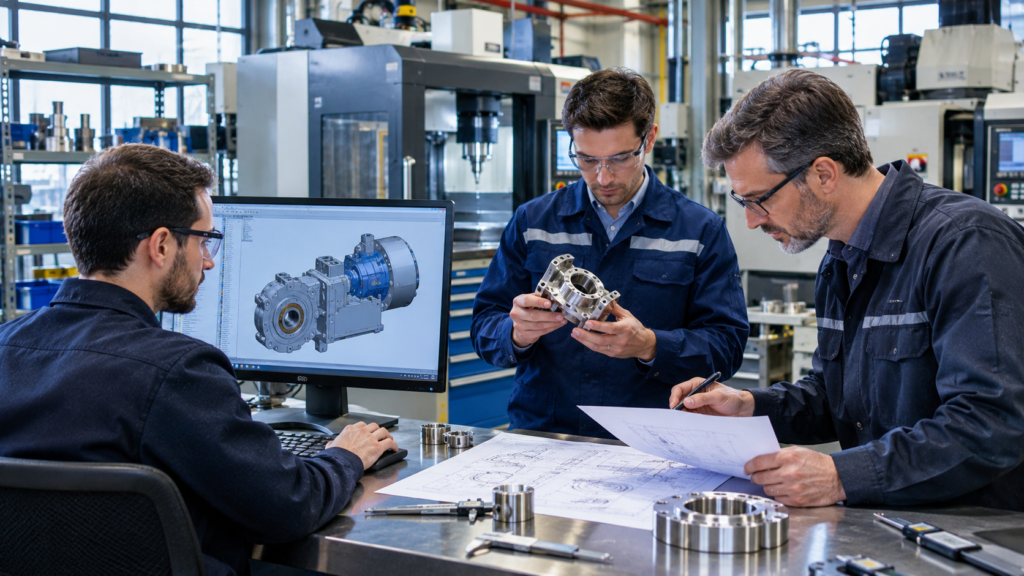
Searching for mechanical engineering companies near me is often the first step for manufacturers, product developers, industrial facility owners, and businesses that need professional mechanical design or equipment engineering services.
However, finding a nearby engineering company does not automatically mean you have found the right technical partner.
Imagine that your manufacturing business needs a custom machine to improve production efficiency. You contact several local engineering companies, but one specializes in building HVAC systems, another manufactures standard industrial components, and the third provides mechanical drafting without engineering analysis.
Although all three operate within the mechanical engineering industry, their capabilities differ significantly.
Choosing the right company requires an understanding of your technical requirements, engineering deliverables, manufacturing constraints, and project objectives.
This guide explains how to find local mechanical engineering companies, evaluate their capabilities, compare proposals, and select an engineering partner for your project.
You can begin your search through the Mechanical Engineering directory on Engineers Mirror.
What Does a Mechanical Engineering Company Do?
Mechanical engineering companies provide design, analysis, development, testing, and consulting services involving mechanical systems, equipment, machinery, and physical products.
Their work may involve developing a new industrial machine, improving an existing mechanical assembly, analyzing equipment performance, designing a thermal system, or preparing a product for manufacturing.
Mechanical engineers often consider several technical factors simultaneously, including material properties, applied forces, operating temperatures, friction, vibration, manufacturing tolerances, and equipment reliability.
A mechanical engineering company may support an assignment from its initial concept through detailed design and prototype validation.
Other companies focus on a narrower part of the engineering process, such as CAD drafting, industrial equipment design, or thermal analysis.
Understanding these differences is essential when comparing providers.
Looking for engineering companies?
Compare 866 verified engineering companies on Engineers Mirror and contact them directly.
What Services Do Local Mechanical Engineering Companies Provide?
Mechanical Design Engineering
Mechanical design engineering involves developing components, assemblies, machinery, and mechanical systems that meet defined performance requirements.
A company providing mechanical design services may work on industrial equipment, specialized machinery, mechanical enclosures, fixtures, production tools, or material handling systems.
Typical deliverables include engineering calculations, three-dimensional models, assembly drawings, material specifications, and manufacturing documentation.
The design should consider how the equipment will operate, how it will be manufactured, and how it can be maintained throughout its intended service life.
Mechanical CAD Design and Drafting
Computer-aided design, commonly known as CAD, allows engineers and designers to develop detailed digital representations of mechanical products and systems.
Mechanical CAD services may include:
- Three-dimensional component modeling
- Mechanical assembly modeling
- Two-dimensional production drawings
- Sheet metal design
- Parametric modeling
- Assembly documentation
- Existing equipment drawing conversion
- Engineering drawing revisions
Some projects require native CAD files that can be edited using specific software. Others may only require neutral exchange formats or production-ready drawings.
Before hiring a provider, confirm which software and file formats will be used.
CAD modeling alone does not necessarily include engineering calculations, safety assessment, or design validation.
Industrial Machine Design
Industrial machine design companies develop mechanical equipment for manufacturing, processing, packaging, material handling, and other production activities.
A custom machine may need to perform a specific operation that commercially available equipment cannot adequately address.
Engineering considerations can include operating loads, production throughput, mechanical motion, component selection, guarding, maintainability, and integration with electrical control systems.
For example, a packaging company may need a custom conveyor arrangement that fits within an existing production area.
The mechanical engineering provider must understand the available space, product characteristics, operating speed, cleaning requirements, and interfaces with surrounding equipment.
Product Development Engineering
Mechanical engineering companies can help businesses transform initial product ideas into technically developed physical products.
Product development may involve concept exploration, mechanical architecture, material selection, detailed design, prototyping, testing, and manufacturing preparation.
For a startup developing a new consumer product, the challenge is not simply creating an attractive three-dimensional model.
The product must also meet its functional requirements, fit together correctly, and be suitable for its intended manufacturing process.
A mechanical engineering consultancy with relevant product development experience can help identify these considerations during the design process.
Finite Element Analysis
Finite element analysis, or FEA, is a numerical engineering method used to investigate how components and systems respond to specified physical conditions.
Depending on the analysis, mechanical engineers may evaluate stress, deformation, vibration, buckling, fatigue, or thermal behavior.
Simulation can provide useful engineering insights, but the quality of the results depends on the assumptions, material data, boundary conditions, and modeling methods used.
A colorful stress plot is not sufficient evidence that a mechanical component is safe or suitable for use.
Ask the engineering company how its analysis will be reviewed, validated, and documented.
Computational Fluid Dynamics and Thermal Engineering
Computational fluid dynamics, commonly known as CFD, is used to analyze fluid flow and related heat transfer behavior.
Mechanical engineering companies may use CFD and thermal analysis when developing cooling systems, ventilation equipment, fluid handling components, industrial processes, or thermally sensitive products.
Relevant project requirements may include pressure losses, airflow distribution, cooling performance, temperature limits, and energy efficiency.
Depending on the application, analytical calculations, physical measurements, or experimental testing may also be necessary.
Mechanical Reverse Engineering
Reverse engineering involves investigating an existing mechanical component or assembly to recreate or understand relevant design information.
A manufacturer may require this service when replacing an obsolete component, updating legacy equipment documentation, or evaluating an existing mechanical assembly.
The process may involve dimensional inspection, three-dimensional scanning, CAD reconstruction, material identification, and functional analysis.
Confirm that you have the necessary intellectual property rights or permissions before commissioning reverse engineering work.
A reconstructed geometric model does not automatically establish the original material properties, manufacturing tolerances, or performance requirements.
Prototyping and Design for Manufacturing
A prototype helps engineers investigate whether a proposed product or component meets selected design objectives before committing to full-scale production.
Depending on the project, prototyping methods may include 3D printing, CNC machining, sheet metal fabrication, or conventional manufacturing techniques.
Design for manufacturing, often called DFM, considers how the proposed design can be manufactured using practical and appropriate production methods.
This may involve reducing unnecessary complexity, evaluating material choices, reviewing tolerances, and improving assembly arrangements.
Some mechanical engineering companies provide prototyping and manufacturing services internally, while others coordinate with external suppliers.
Which Type of Mechanical Engineering Company Do You Need?
Mechanical engineering is a broad discipline. Choosing the correct specialist can make your search significantly more efficient.
| Project requirement | Recommended engineering specialty |
|---|---|
| Custom production machinery | Industrial machine design |
| New physical product development | Mechanical product development |
| Manufacturing-ready drawings | Mechanical CAD and drafting |
| Component stress evaluation | FEA and mechanical analysis |
| Electronics cooling | Thermal engineering and CFD |
| Existing equipment improvement | Industrial mechanical engineering |
| Obsolete component recreation | Mechanical reverse engineering |
| New production fixture | Tooling and fixture design |
| Prototype development | Mechanical design and prototyping |
| Commercial HVAC system | Mechanical building services or MEP engineering |
| Pressure vessel or piping design | Relevant specialist mechanical engineering |
For projects primarily involving technical building systems, explore the MEP & Building Services directory on Engineers Mirror after confirming that the provider offers the required HVAC or mechanical building services.
For broader mechanical equipment and product engineering requirements, a dedicated mechanical engineering consultancy may be more appropriate.
When Should You Hire a Mechanical Engineering Company?
Mechanical engineering services can be valuable at several stages of a project.
A business developing a new product may need engineering assistance before investing in prototypes or production tooling.
A manufacturer planning an equipment upgrade may require an assessment of its existing machinery before purchasing replacement components.
An industrial facility experiencing recurring equipment problems may need technical analysis before selecting a repair or redesign strategy.
Consider contacting a mechanical engineering company when:
- You need to develop a new mechanical product.
- Existing equipment is not meeting operational requirements.
- Your business requires specialized production machinery.
- You need manufacturing-ready CAD models and drawings.
- A mechanical component requires technical analysis.
- You want to evaluate prototype performance.
- An existing mechanical system needs modernization.
- Your internal engineering team requires specialist support.
Early engineering involvement may help identify technical constraints before major manufacturing or equipment procurement decisions are made.
How to Find Mechanical Engineering Companies Near You: 10 Essential Steps
Step 1: Define the Mechanical Engineering Problem
Begin by identifying what the engineering company needs to accomplish.
Avoid starting with an overly general request such as asking for a machine to improve production.
Instead, describe the intended operation, current limitations, required performance, available installation space, operating environment, and interfaces with other equipment.
For example, a manufacturer might need a custom material handling system capable of transferring components between two existing production stations.
The engineering company needs to understand the component characteristics, required throughput, available space, operating schedule, and applicable safety requirements.
A clear project brief should include relevant drawings, photographs, performance targets, operating conditions, anticipated deliverables, and project constraints.
Where the technical solution is uncertain, consider commissioning a preliminary engineering assessment or concept development phase.
Step 2: Use Specific Mechanical Engineering Search Terms
Searching for mechanical engineering companies near me can help identify local providers, but more specific search terms often produce more relevant results.
Combine the required engineering discipline with your city, state, industrial sector, or project type.
| Required service | Suggested search term |
|---|---|
| Specialized machinery | Custom machine design companies near me |
| Mechanical drawings | Mechanical CAD design services near me |
| New product | Mechanical product development firms |
| Structural component analysis | FEA engineering consultants near me |
| Industrial equipment | Industrial mechanical engineering firms |
| Prototype development | Mechanical prototyping companies near me |
| Heat transfer analysis | Thermal engineering consultants |
| Equipment reconstruction | Mechanical reverse engineering services |
| Building cooling systems | HVAC mechanical engineering consultants |
| Manufacturing equipment | Mechanical engineering firms for manufacturing |
For projects requiring physical inspections or equipment integration, search around the actual facility location rather than the location of your administrative office.
If you are unsure which engineering discipline is appropriate, read our broader guide to finding engineering companies near you.
Step 3: Search a Specialist Engineering Directory
Professional engineering directories provide another way to discover companies beyond general search results.
A specialized directory can help buyers investigate providers according to engineering services, technical capabilities, and geographic markets.
The Engineers Mirror Mechanical Engineering directory displayed 42 company listings when reviewed on November 25, 2026.
The platform also includes related engineering specialties that may be relevant to mechanical design, industrial development, and prototyping.
Start by reviewing the available company profiles.
Identify companies offering the specific technical services your project requires and confirm their advertised capabilities directly.
For American projects, you can also explore the Engineering Companies in the United States directory.
Directory listings are a useful research starting point, but they do not replace project-specific technical due diligence.
Step 4: Review Relevant Industry and Equipment Experience
A mechanical engineering company may have extensive experience without having worked on equipment similar to yours.
For example, a consultancy that designs consumer products may not have the appropriate experience for a heavy industrial lifting system.
Similarly, a company specializing in HVAC equipment may not provide the detailed mechanical engineering needed for a custom manufacturing machine.
Request examples of assignments involving comparable operating conditions, materials, mechanical loads, manufacturing technologies, or industrial requirements.
Ask what the company was responsible for on each project.
Did it develop the original concept? Was it responsible for detailed engineering calculations? Did it prepare the manufacturing drawings? Did it support prototype testing?
Understanding the provider’s actual responsibilities gives you a clearer picture of its capabilities.
Step 5: Verify Engineering Qualifications and Applicable Standards
Mechanical engineering projects may involve professional licensing requirements, industry standards, regulatory obligations, and contractual technical specifications.
The requirements depend on the jurisdiction, equipment type, intended application, and nature of the engineering work.
In the United States, certain regulated professional engineering services require an appropriately licensed Professional Engineer.
The National Council of Examiners for Engineering and Surveying provides information about engineering licensure and the qualifications associated with professional practice.
Where professional licensing is required, verify the responsible engineer’s credentials and any applicable company authorization through the relevant state licensing board.
Mechanical equipment may also be subject to specific engineering standards.
The American Society of Mechanical Engineers’ codes and standards resources cover areas including pressure technology, piping, power equipment, and other mechanical engineering applications.
Ask the engineering company to identify the standards and regulatory requirements relevant to your project.
Do not assume that every mechanical design requires the same certifications or standards.
Step 6: Evaluate CAD, Simulation, and Engineering Capabilities
Engineering software can support mechanical design and analysis, but owning specialized software does not establish technical competence.
Ask potential providers which engineering methods and tools they use and how those methods relate to your project.
Mechanical engineering teams may work with platforms such as SolidWorks, Autodesk Inventor, Siemens NX, Creo, CATIA, or other engineering software.
The appropriate platform depends on your requirements and existing design environment.
If your business already maintains equipment models using a particular software platform, compatibility may be important.
For simulation projects, ask how the company determines loads, material properties, operating conditions, and analysis assumptions.
Also clarify whether independent calculations, testing, or other verification methods will be used.
The objective is to identify the provider’s engineering process rather than simply collecting a list of software names.
Step 7: Confirm Engineering Validation and Quality Assurance
A mechanical design should be evaluated against its agreed requirements.
Depending on the project, engineering validation may involve calculations, design reviews, tolerance assessments, simulations, prototype testing, or functional performance testing.
For equipment operating in demanding environments, additional specialist evaluations may be required.
Ask the engineering company how it manages:
- Design reviews and approvals
- Technical calculation checks
- Drawing revision control
- Material and component specifications
- Manufacturing tolerances
- Equipment safety requirements
- Prototype evaluation
- Documented design changes
For machinery projects, responsibility for guarding, safety-related control functions, risk assessments, and other protective measures should be allocated clearly.
No engineering company should be selected solely because it promises that a design will work without explaining how its performance will be evaluated.
Step 8: Confirm Deliverables and Intellectual Property Ownership
Mechanical engineering projects frequently produce digital models, technical drawings, calculations, reports, and proprietary design information.
Ownership and usage rights should be addressed before design work begins.
Determine whether the engineering company will provide editable native CAD files, neutral exchange files, manufacturing drawings, bills of materials, and technical reports.
Also clarify the ownership of newly developed intellectual property, the licensing of any pre-existing design technology, and your rights to modify or manufacture the final design.
A confidentiality agreement may be appropriate when the project involves commercially sensitive technology.
Never assume that paying an engineering fee automatically transfers every intellectual property right.
These arrangements should be specified in the professional agreement.
Step 9: Request Comparable Mechanical Engineering Proposals
Once you have identified suitable companies, send them consistent project information.
A detailed proposal should explain the recommended engineering approach, project stages, deliverables, assumptions, fees, schedule, and exclusions.
For a custom machine design project, one provider may include concept development, detailed modeling, engineering calculations, and manufacturing drawings.
Another may only provide CAD modeling based on your existing design.
Comparing their prices without comparing their scopes could lead to unexpected expenses.
Use the Engineering RFQ Template from Engineers Mirror to prepare a structured request for clearly defined engineering services.
For assignments where the technical solution is still uncertain, request a proposal explaining the provider’s recommended investigation and design process.
Step 10: Select the Most Suitable Mechanical Engineering Partner
The final selection should consider technical capabilities, relevant experience, professional qualifications, communication, project availability, and overall value.
A company located nearby may offer convenient equipment inspections and prototype development support.
However, a specialist engineering consultancy located farther away may have more relevant expertise.
Before signing an agreement, confirm the responsible engineering team, project milestones, technical acceptance criteria, design revision process, deliverables, and payment terms.
Establish how engineering changes will be approved and what happens if the project scope changes.
The best-fit mechanical engineering company is the provider capable of meeting your project’s requirements through a clearly defined and technically appropriate engineering process.
Mechanical Engineering Deliverables You Should Expect
Different engineering assignments require different outputs.
The following table provides examples of common mechanical engineering deliverables.
| Deliverable | Purpose |
|---|---|
| Engineering requirements document | Defines functional and technical objectives |
| Concept design | Explores potential mechanical solutions |
| 3D CAD models | Documents component and assembly geometry |
| Assembly drawings | Shows component relationships and assembly details |
| Manufacturing drawings | Defines required dimensions, tolerances, and specifications |
| Bill of materials | Identifies materials and components |
| Engineering calculations | Supports technical design decisions |
| FEA report | Documents specified mechanical analysis |
| CFD or thermal report | Documents fluid flow or thermal analysis |
| Prototype evaluation report | Records selected test results |
| Design revision records | Tracks approved engineering changes |
| Maintenance documentation | Supports agreed service and maintenance requirements |
Not all projects require every deliverable.
Your agreement should identify which outputs are included, their required formats, and the criteria used to evaluate their completion.
Mechanical Engineering Company vs Machine Manufacturer
A mechanical engineering company and a machine manufacturer may offer overlapping services, but their primary responsibilities can differ.
An engineering consultancy generally focuses on technical planning, design, analysis, and documentation.
A machine manufacturer typically produces and assembles mechanical equipment.
Some businesses offer integrated engineering, fabrication, and installation services.
| Consideration | Mechanical engineering consultancy | Machine manufacturer |
|---|---|---|
| Primary focus | Engineering design and analysis | Manufacturing and assembly |
| Concept development | Often available | Depends on provider |
| Engineering calculations | May be a core service | Confirm scope |
| CAD documentation | Common engineering deliverable | Depends on agreement |
| Fabrication resources | May use external suppliers | Often available internally |
| Equipment installation | May coordinate or advise | May provide installation |
| Independent design review | Potentially available | Confirm independence |
If you already have a completed and validated design, a manufacturing company may be the appropriate next partner.
If the technical design is still under development, specialist mechanical engineering services may be necessary first.
How to Compare Mechanical Engineering Companies Near Me
A structured evaluation framework can help private-sector buyers compare technically qualified providers.
The following weights are an illustrative starting point rather than an industry-mandated scoring system.
| Evaluation criterion | Suggested weight |
|---|---|
| Relevant mechanical engineering experience | 25% |
| Technical design and analysis capabilities | 20% |
| Validation and quality assurance | 15% |
| Deliverables and file ownership | 15% |
| Manufacturing and prototyping knowledge | 10% |
| Communication and availability | 10% |
| Commercial value | 5% |
| Total | 100% |
Mandatory licenses, safety-related capabilities, and regulatory qualifications should be treated as eligibility requirements where applicable.
Adjust the remaining evaluation criteria according to the complexity and priorities of your project.
A simple component drafting assignment will require a different evaluation process from a complex industrial machine development project.
How Much Do Mechanical Engineering Companies Charge?
Mechanical engineering fees vary considerably because the services themselves cover a wide range of technical activities.
Creating a CAD drawing from an existing component is different from developing a complete industrial machine that requires mechanical calculations, equipment integration, prototype testing, and manufacturing documentation.
Factors That Affect Mechanical Engineering Costs
Common factors include:
- Technical complexity
- Availability of existing design information
- Number of components and assemblies
- Concept development requirements
- Required engineering calculations
- Simulation and validation requirements
- Prototype development
- Manufacturing documentation
- Professional licensing obligations
- Number of design revisions
- Project schedule
Engineering companies may use hourly billing, fixed project fees, milestone-based payments, or phased development agreements.
Where substantial technical uncertainty exists, a phased agreement can allow the initial engineering findings to inform the scope of later work.
Example of Comparing Mechanical Engineering Proposals
Consider two hypothetical proposals for developing a custom industrial equipment assembly.
| Engineering service | Company A | Company B |
|---|---|---|
| Concept development | $1,500 | Included |
| Detailed CAD design | $3,500 | Included |
| Engineering calculations | $2,000 extra | Included |
| Manufacturing drawings | $1,500 extra | Included |
| Agreed design review | $1,000 extra | Included |
| Comparable total | $9,500 | $8,500 |
Company A may appear more affordable when only its initial concept and CAD design fees are considered.
However, after comparing equivalent engineering services, Company B offers a lower total price in this example.
These amounts are hypothetical illustrations, not verified market rates.
Prototype fabrication, physical testing, installation, and other third-party expenses would need to be evaluated separately if excluded from both proposals.
Local Mechanical Engineering Firms vs Remote Engineering Consultants
Not every mechanical engineering project requires a nearby engineering office.
For design, technical calculations, simulation, and digital documentation, remote engineering teams may provide suitable services.
However, industrial equipment assessments, facility measurements, prototype development, and machinery integration may benefit from local engineering support.
| Consideration | Local engineering company | Remote engineering consultant |
|---|---|---|
| Equipment inspections | Often easier to arrange | May require travel or local partners |
| Prototype reviews | Potentially convenient | Depends on development arrangement |
| Specialist expertise | Depends on local availability | Wider geographic selection |
| Design collaboration | In-person and remote | Primarily digital |
| Travel costs | Potentially lower | May involve additional expenses |
| Manufacturing coordination | May have local connections | Depends on supplier network |
| CAD and simulation services | Suitable when qualified | Often suitable when qualified |
The appropriate working arrangement depends on how frequently the engineers need physical access to the equipment, facility, or prototype.
For highly specialized analysis, limiting your search to a small geographic area may unnecessarily reduce your options.
12 Questions to Ask Before Hiring a Mechanical Engineering Company
Use these questions during your initial technical discussion:
- Have you completed mechanical engineering projects similar to ours?
- Which engineers will be responsible for the assignment?
- Do you have the professional qualifications required for this project?
- Which engineering standards and regulatory requirements may apply?
- What design software and engineering methods will you use?
- How will you verify the engineering calculations and design assumptions?
- Will we receive editable native CAD files and manufacturing drawings?
- Are intellectual property ownership and confidentiality addressed?
- Can you support prototype development or manufacturing coordination?
- Which services and revisions are included in your proposed fee?
- How will design changes and additional work be managed?
- What is your realistic project schedule?
Record the responses and use them to compare providers on a consistent basis.
Common Mistakes When Searching for Mechanical Engineering Companies Near Me
Choosing a Provider Based Only on CAD Skills
Creating a detailed digital model is not the same as completing mechanical engineering design.
Confirm that the provider can perform the required calculations, material evaluations, and technical validation.
Ignoring Manufacturing Requirements
A product that looks functional in a digital model may still be expensive or difficult to manufacture.
Discuss production methods, component availability, tolerances, and assembly requirements early.
Overlooking Equipment Safety
Mechanical equipment may present hazards involving moving components, stored energy, elevated temperatures, pressure, or other operating conditions.
The appropriate risk assessments and protective design measures should be addressed by qualified professionals.
Failing to Define Technical Acceptance Criteria
Without clear performance requirements, it can be difficult to determine whether a mechanical design meets its intended objectives.
Agree on the required technical outcomes before detailed development begins.
Assuming Prototype Success Guarantees Production Performance
A prototype may evaluate selected functions without representing the final manufacturing materials, operating environment, or long-term reliability.
Clarify what the prototype is intended to demonstrate.
Not Confirming Design File Ownership
A buyer may receive PDF drawings but discover that editable CAD files are excluded.
Establish file formats, intellectual property rights, and manufacturing usage permissions in writing.
Selecting the Cheapest Engineering Proposal
An inexpensive design proposal may exclude engineering analysis, validation, manufacturing documentation, or important project revisions.
Compare equivalent scopes before choosing a provider.
How to Find Mechanical Engineering Companies Near Me Using Engineers Mirror
Engineers Mirror is a specialist B2B directory that helps buyers discover engineering companies, consultants, manufacturers, and industrial service providers.
The platform displayed 42 listings in its Mechanical category and 41 listings in its separate Design & Simulation category when reviewed on November 25, 2026.
These categories include different technical specialties and geographic markets. Listing totals may change over time.
To begin your search, visit the Mechanical Engineering directory.
Search using your required service, such as mechanical design, equipment engineering, or prototyping.
Narrow the available results by location and review relevant company profiles.
Contact potential providers to confirm their engineering experience, technical capabilities, availability, and commercial arrangements.
If your project requires several engineering disciplines, submit a project brief through the Engineers Mirror homepage.
The platform provides free buyer access and project matching according to its published service information.
Always verify the professional qualifications, technical capabilities, references, and contractual terms of individual providers independently.
Frequently Asked Questions
How do I find mechanical engineering companies near me?
Search using your required mechanical engineering specialty and project location. Use specialist engineering directories, company websites, professional referrals, and local search results to identify providers. Compare their relevant experience, technical capabilities, qualifications, and engineering proposals before hiring.
What services do mechanical engineering companies provide?
Mechanical engineering companies may provide machine design, CAD modeling, mechanical analysis, equipment development, product engineering, thermal analysis, prototyping, and manufacturing support. Available services depend on the company’s specialization.
How much does it cost to hire a mechanical engineering company?
Engineering fees depend on project complexity, technical requirements, design deliverables, simulations, prototype development, and the required schedule. Request a written, project-specific proposal rather than relying on a generic average.
Can mechanical engineering companies design custom machinery?
Yes. Companies specializing in industrial machine design can develop custom manufacturing, material handling, packaging, and other mechanical equipment. Confirm their experience with comparable machinery and applicable safety requirements.
Do mechanical engineering companies provide CAD models?
Many mechanical engineering companies provide two-dimensional drawings and three-dimensional CAD models. Confirm whether editable native files, manufacturing drawings, assembly documentation, and usage rights are included in the proposal.
What is the difference between mechanical engineering and mechanical CAD design?
Mechanical engineering involves technical analysis, design decisions, material evaluation, and performance considerations. CAD design focuses on creating digital models and drawings. A project may require both capabilities.
Do mechanical engineers need a PE license in the United States?
Certain regulated engineering activities require an appropriately licensed Professional Engineer. Other activities may fall under specific statutory exemptions. Requirements vary by jurisdiction and engineering scope.
Can I hire a mechanical engineering company remotely?
Yes. Many mechanical design, CAD, simulation, and consulting assignments can be performed remotely. Equipment inspections, prototype validation, installation support, and local licensing requirements may require additional arrangements.
Can mechanical engineering companies manufacture my product?
Some companies provide integrated engineering, prototyping, and manufacturing services. Others specialize in design and coordinate production through external manufacturers. Confirm the company’s actual manufacturing capabilities and responsibilities.
Where can I compare mechanical engineering companies online?
Engineers Mirror provides a Mechanical Engineering directory where buyers can explore engineering providers, review available service information, and contact companies according to their technical requirements and location.
Final Thoughts
Finding mechanical engineering companies near me is not simply a matter of choosing the nearest consultancy or the lowest-priced engineering proposal.
The right engineering partner should understand the intended function of your equipment or product, the operating environment, manufacturing requirements, technical limitations, and required engineering deliverables.
Begin with a clear project brief. Identify the relevant mechanical engineering specialty, investigate comparable projects, verify professional qualifications where applicable, and compare proposals using equivalent technical scopes.
Pay particular attention to design validation, manufacturing documentation, engineering file ownership, and project acceptance criteria.
A well-selected mechanical engineering company can help your business make better-informed decisions throughout equipment development, product engineering, and industrial improvement projects.
Ready to find a mechanical engineering partner?
Explore the Mechanical Engineering directory on Engineers Mirror to discover mechanical design firms, industrial engineering providers, and related technical service companies.
For US-based projects, browse our Engineering Companies in the United States directory.
You can also submit your project requirements through Engineers Mirror to request connections with potentially suitable engineering partners.
Editorial disclaimer: This article provides general engineering procurement guidance. Professional licensing, equipment safety requirements, applicable standards, and engineering obligations vary by jurisdiction and application. Obtain project-specific technical advice from appropriately qualified engineering professionals.