
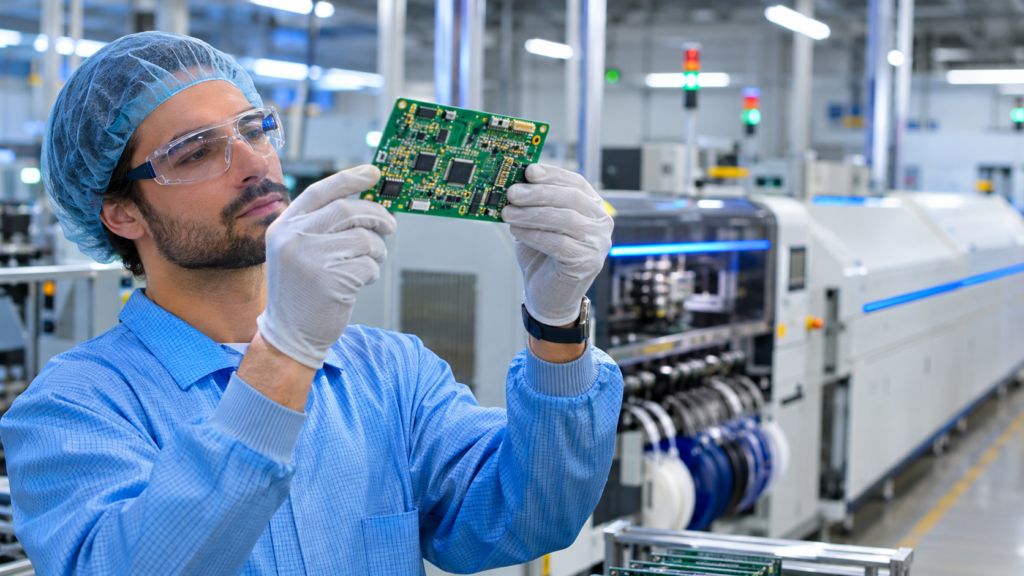
You have a finished PCB design, a bill of materials, and a launch date. The next decision can make or break the product: which PCB assembly company will build it? Pick well and your prototypes arrive working, your quotes stay stable, and scaling to production is smooth. Pick badly and you face missing parts, solder defects, silent design changes, and a schedule that keeps slipping.
This guide explains how to choose a PCB assembly company. You will learn the difference between PCB fabrication, assembly, and contract manufacturing, what the IPC quality classes mean, the options for sourcing parts, a nine-step selection process, what drives cost, red flags to avoid, and the questions to ask before you place an order. It is written for engineers, product managers, and buyers in the USA, Canada, and the UK.
PCB Fabrication vs PCB Assembly vs Contract Manufacturing
These terms are often mixed up, and mixing them up leads to the wrong supplier.
| Term | What it means | Typical output |
|---|---|---|
| PCB fabrication | Making the bare printed circuit board from your design files | Bare boards |
| PCB assembly (PCBA) | Placing and soldering components onto the board | A populated, working circuit board |
| Contract manufacturing (EMS) | Electronics manufacturing services that can include assembly, sourcing, testing, cables, and full product build | Finished subassemblies or complete products |
| Box build | Integrating boards, cables, enclosures, and mechanical parts into a finished product | A complete device |
Some companies only fabricate bare boards. Some only assemble boards you supply. Others do everything. Before you start, decide which services you need, because it changes who you should talk to.
Types of PCB Assembly Companies
- Prototype and quick-turn providers. Built for fast turnaround on small quantities. Good for early designs and design iterations.
- High-mix, low-volume contract manufacturers. Handle many different products in small to medium runs, often with higher quality systems and documentation.
- High-volume manufacturers. Optimized for large production runs, where unit cost matters most.
- Digital manufacturing platforms. Offer online quoting, sourcing, and production tracking, often through a network of factories.
- Full-service EMS and box-build providers. Cover assembly, wire harnesses, cable assemblies, mechanical integration, and testing.
- Domestic, offshore, and hybrid. Some firms build locally, some use overseas factories, and others combine local engineering and customer service with overseas production. Each model has different trade-offs in cost, lead time, and control.
IPC Quality Classes: What They Mean
If you take one technical point from this guide, make it this: agree the IPC class before you order. IPC-A-610, “Acceptability of Electronic Assemblies,” is the most widely used standard for judging what a finished assembly should look like. It has three classes.
| IPC class | Typical use | What it means |
|---|---|---|
| Class 1 | General electronics | Most lenient criteria; function matters most |
| Class 2 | Dedicated service electronics | Longer life and reliable performance desired; most commonly requested |
| Class 3 | High-performance, high-reliability products | Strictest criteria; continued performance is critical |
According to an I-Connect007 article by an EMS marketing director, Class 2 is typically the most requested for non-critical assemblies, while Class 3 is aimed at more critical products and may come at a premium because it can mean slower placement, more inspection, and higher scrap. For a plain-English comparison, see Escatec’s guide to IPC-A-610 classes.
A few related standards from IPC are worth knowing:
- IPC-A-600. Acceptability of printed boards (the bare board).
- IPC-6012. Qualification and performance specification for rigid printed boards.
- J-STD-001. Requirements for soldered electrical and electronic assemblies (the soldering process).
- IPC-2581. A standard format for transferring design and manufacturing data.
If your purchase order does not state a class, many contract manufacturers default to Class 2. If you need something different, write it on the drawing and the purchase order.
Turnkey vs Partial Turnkey vs Consignment
You also need to decide who buys the parts.
| Model | Who buys components | Best for |
|---|---|---|
| Full turnkey | The manufacturer | Teams that want one partner to handle everything |
| Partial turnkey | Both sides share | Teams that supply special or hard-to-get parts |
| Consignment (kitted) | You | Teams with their own sourcing or strict part control |
Turnkey saves you time, but it also means the manufacturer controls the supply chain. Ask how they source parts, who approves substitutions, and how they handle shortages. For consigned builds, make sure you send enough overage to cover normal placement losses.
9 Steps to Choose the Right PCB Assembly Company
Step 1: Prepare a Complete Data Package
A weak data package produces a weak quote. Before you contact anyone, gather:
- Gerber files or another fabrication data format such as ODB++ or IPC-2581
- A clean bill of materials with manufacturer part numbers
- A pick-and-place (centroid) file
- An assembly drawing with notes
- Your IPC class and any special requirements
- Test requirements and expected quantities, from prototype to production
Step 2: Match Capabilities to Your Board
Look at what your design needs: surface-mount parts, through-hole parts, mixed technology, BGAs, fine-pitch components, flex or rigid-flex boards, conformal coating, or box-build. Ask the company to confirm it routinely builds boards like yours, not just that it “can.”
Step 3: Check the Quality System and Certifications
Ask for current certificates, and check that the scope fits your product:
- ISO 9001 for a general quality management system
- AS9100 for aerospace work
- ISO 13485 for medical devices
- IATF 16949 for automotive
- UL recognition where relevant
- IPC-trained inspectors for the class you need
Request the certificate itself and check the date. A quality system mentioned on a website may be out of date.
Step 4: Ask About Design for Manufacturability (DFM) Review
A good PCB assembly company reviews your files before building and reports issues such as footprint mismatches, tight spacing, missing data, or parts that are hard to source. Ask how DFM works, how fast it is, and who answers your questions. Catching a problem here costs far less than catching it after boards are built.
Step 5: Understand Component Sourcing
Parts availability is a common cause of delay. Ask how the company sources components, what authorized distributors it uses, how it prevents counterfeit parts, how it handles shortages, and whether it will propose alternates for your approval. Never let a manufacturer swap parts without written sign-off.
Step 6: Review Testing and Inspection
Ask what inspection and test steps are standard and which are extra. Common options include automated optical inspection, X-ray inspection for BGAs, in-circuit or flying-probe testing, and functional testing using your test procedure. The right mix depends on your IPC class and risk.
Step 7: Check Lead Time and Scalability
Find out typical lead times for prototypes and production, and what happens when you scale. Ask how the company handles new product introduction, and whether the line you prototype on is the one you will produce on. Switching suppliers between prototype and production adds risk.
Step 8: Consider Location, Logistics, and IP
Domestic production can offer shorter shipping, easier communication, and simpler compliance. Offshore production can reduce unit cost. Hybrid models split the difference. Whatever you choose, ask about shipping, customs, duties, time-zone overlap, and how your design files are protected. For defense or export-controlled work in the US, ask about the compliance requirements that apply to your program.
Step 9: Get the Contract and Communication Right
Agree an NDA, who owns the data and tooling, how engineering changes are handled, what the warranty covers, and how defective boards are handled. Ask who your day-to-day contact will be, and how quickly they respond.
What Drives PCB Assembly Cost?
Published prices vary widely by design, quantity, and supplier, so we do not quote per-board figures here. Instead, understand what moves the price:
- Quantity. Setup costs are spread across more boards in larger runs, so unit cost usually falls with volume.
- Board complexity. Layer count, materials, controlled impedance, fine-pitch parts, and flex or rigid-flex designs all add cost.
- Component cost and availability. Parts are often the largest share of a turnkey order, and shortages can raise prices.
- Assembly complexity. Mixed technology, BGAs, and through-hole parts add steps.
- IPC class. Class 3 may cost more because of slower placement, extra inspection, and scrap.
- Testing and inspection. More test coverage costs more, but catches defects earlier.
- One-time costs. Setup, programming, stencils, and test fixtures are often charged once per design.
- Lead time. Rush orders usually carry a premium.
- Extras. Conformal coating, cable assemblies, and box-build services add to the quote.
To compare suppliers fairly, ask every one to quote the same package. Our free engineering RFQ template gives you a ready-made request, a response form, and a scoring sheet, with an add-on section for manufactured parts.
Red Flags to Avoid
- A quote that does not state the IPC class, quantities, or what is excluded
- No DFM review before you pay
- Reluctance to share certificates or inspection records
- Vague answers about where boards are actually made
- A price far below every other quote, with no explanation
- Component substitutions without written approval
- No clear process for engineering changes
- No plan for testing, or no willingness to use your test procedure
- Pressure to approve a build before you have seen the DFM report
12 Questions to Ask Before You Order
- Which IPC class do you build to by default, and can you build to the class I need?
- Which of your certificates apply to my product, and can I see them?
- Do you do a DFM review, and what does it cover?
- Do you offer turnkey, partial turnkey, and consignment?
- How do you source parts, and how do you prevent counterfeits?
- How do you handle shortages and proposed alternates?
- What inspection and tests are included in the price?
- What are your lead times for prototypes and for production?
- Where will my boards be made, and where will they be assembled?
- How do you protect my design files?
- How do you handle engineering changes and defective boards?
- Can I speak to a recent customer with a similar product?
From Prototype to Production
Many products stumble when they move from a handful of prototypes to hundreds or thousands of units. Ask early how the supplier handles that transition:
- Will the same people and line build the production units?
- What documentation will you need to freeze, such as the BOM, assembly notes, and test procedure?
- How are component lifecycles and second sources managed?
- What is the plan if a key part goes on allocation?
If your product also needs a custom enclosure or mechanical parts, our guides on how to hire a mechanical CAD design company and how to choose an industrial automation company cover the hardware and controls side.
Find a PCB Assembly Company on Engineers Mirror
Engineers Mirror is an independent directory that helps you compare engineering and manufacturing companies by category, location, and specialty. Its PCB Manufacturing & Assembly category currently lists four companies, and the wider Circuit Design category includes more PCB-related firms. Here is what the profiles say.
United States
- Electro Circuits (Stafford, Texas). A PCB manufacturing and assembly company covering PCB design, fabrication, assembly, prototyping, and turnkey electronics. The profile lists single-sided, double-sided, and multilayer boards, plus flex, rigid-flex, aluminum, ceramic, LED, and specialty materials, along with controlled impedance, electrical testing, conformal coating, stencils, wire and cable harnessing, and box-build. It says boards are manufactured through suppliers in the USA, South Korea, and China.
- MacroFab, Inc. (Houston, Texas). An electronics manufacturing and PCB assembly company with a digital platform for quoting, component sourcing, production tracking, and supply chain information. The profile lists SMT, through-hole, mixed-technology, BGA, LGA, and fine-pitch assembly, for prototype and full-scale production, through a North American network covering the US, Canada, and Mexico.
- Stone Technical Group LLC (Tulsa, Oklahoma). An electronic contract manufacturer focused on high-mix, low- to medium-volume subassemblies for commercial and government customers, including military-specification products. The profile lists SMT, through-hole, hand soldering, cable and wire harness assembly, overmolded assemblies, and mechanical assembly, and mentions an ISO 9001 quality system, so ask for the current certificate.
United Kingdom
- Tate Circuit Industries Limited (Lichfield, Staffordshire). A PCB manufacturer and supplier of bare boards, established in 1974 according to its profile, covering prototypes, small batches, high-volume runs, multilayer, flexible, and metal-core boards, and stencils. UK engineering and customer service work with a manufacturing facility in Shenzhen, and the profile mentions ISO 9001 and UL approval. Note that this is bare board fabrication, so you would need an assembler as well.
Other listings in the Circuit Design category include A2Z Electronics LLC in Elgin, American Circuits in Charlotte, Bay Area Circuits in Fremont, ABL Circuits Ltd, and AS&R Circuits Pvt. Ltd. in the UK. Check each profile and website for the services it offers.
You can also browse Embedded Systems and Prototyping companies, see providers in Houston, or browse all companies in the United States and the United Kingdom. If you want to see how another Houston market looks, read our guide to industrial automation companies in Houston. A listing is not an endorsement, so always verify certifications, quality records, and references before you order.
Prefer to send one brief and let manufacturers come to you? Use the project form on the Engineers Mirror homepage. Pick PCB Manufacturing & Assembly as the service, choose a budget range and timeline, and describe your board. It is free for buyers, and providers reply to you directly.
If you run a PCB or electronics manufacturing company, you can list your company for free, claim your listing to add your capabilities and certifications, or look at the Featured plans to appear at the top of your category page.
Final Thoughts on Choosing a PCB Assembly Company
The best PCB assembly company for your product is not always the cheapest or the biggest. It is the one that builds boards like yours, agrees the IPC class and test plan up front, reviews your design before building, manages parts sourcing openly, and communicates clearly when something goes wrong.
Prepare a complete data package, decide your sourcing model, shortlist two or three suppliers, check certificates and references, and compare written quotes on more than price. Do that and your prototypes will be easier to build, and your production ramp will be easier to control.
Ready to compare? Browse the PCB Manufacturing & Assembly category on Engineers Mirror, or send one project brief and let the right manufacturers come to you.
Frequently Asked Questions
What does a PCB assembly company do?
A PCB assembly company places and solders components onto printed circuit boards to produce working circuit boards. Many also handle component sourcing, testing, cable assemblies, and full product assembly, which is often called contract manufacturing.
What is the difference between PCB fabrication and PCB assembly?
Fabrication makes the bare board from your design files. Assembly places and solders components onto that board. Some companies do only one, and others do both, so confirm which service you are buying.
What does IPC Class 2 vs Class 3 mean?
They are quality classes under IPC-A-610. Class 2 covers dedicated service electronics where longer life and reliable performance are desired, and it is typically the most requested. Class 3 covers high-performance products where continued performance is critical, with stricter criteria that may add cost.
How much does PCB assembly cost?
It depends on quantity, board complexity, component costs, IPC class, testing, and lead time. Setup costs such as stencils and programming are often charged once per design. Request written quotes for the same data package from at least two or three suppliers.
Should I choose a domestic or overseas PCB assembly company?
Domestic production can offer shorter shipping, easier communication, and simpler compliance. Overseas production can lower unit cost, and hybrid models combine local engineering with overseas factories. The best choice depends on your volume, schedule, compliance needs, and how much control you want.
What files do I need to get a PCB assembly quote?
Typically Gerber files or another fabrication data format, a bill of materials with manufacturer part numbers, a pick-and-place file, and an assembly drawing. State your IPC class, test requirements, and quantities as well.
Looking for engineering companies?
Compare 821 verified engineering companies on Engineers Mirror and contact them directly.